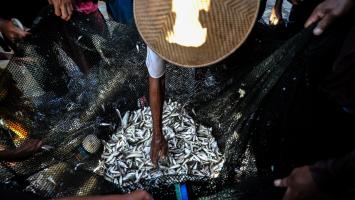
Southeast Asia has the potential to become an epicenter of the $3-trillion global blue economy. However, it faces sustainability and financing challenges. Photo credit: ADB.
The 4th ASEAN Blue Economy Forum in Manila provided high-level strategic guidance and facilitated technical exchange and peer learning on blue economy development and regional cooperation.
Southeast Asia is banking on the blue economy to become its new engine of growth. It is the region’s answer to the triple planetary crisis of accelerating climate change, biodiversity loss, and pollution, which threatens hard-won gains and future growth.
With a regional framework and implementation plan already in place, the task at hand is to scale investments that unlock the economic value of aquatic resources in sustainable and inclusive ways.
Hosted by the Philippines as this year’s ASEAN chair, the 4th ASEAN Blue Economy Forum in Manila focused on how ASEAN can move from policy to action with the twin objectives of protecting natural resources and creating prosperity for all people in the region. The Asian Development Bank (ADB) and the Economic Research Institute for ASEAN and East Asia (ERIA) supported the event, which was held from 24 to 25 August.
The forum was designed for whole-of-society participation. It brought together representatives from government, development partners, financial institutions, academia, indigenous peoples and local communities, youth, civil society organizations, and the private sector from across the region.
Discussions centered on practical actions, partnerships, financing, and institutional cooperation in ecosystem resilience, natural capital, marine pollution and circularity, sustainable financing, infrastructure, renewable energy, community-based development, sustainable fisheries, and ecotourism.
High potential
Southeast Asia has the potential to become an epicenter of the $3-trillion global blue economy. However, it faces sustainability and financing challenges.
“Our region is home to some of the world’s most important marine and coastal ecosystems while millions of our people depend directly or indirectly on these resources for their livelihoods,” said the Philippines’ Department of Trade and Industry Undersecretary Allan B. Gepty, who currently chairs the ASEAN Coordinating Task Force on the Blue Economy, at the opening session of the forum. “But concurrently our oceans are facing increasing pressures from climate change, marine pollution, biodiversity loss, coastal degradation, and unsustainable resource use.”
According to an OECD report, Southeast Asia’s share in the global ocean economy is growing, expanding to 10.7% in gross value-added terms in 2019 from 7.4% in 1995, but its share in ocean-related official development assistance is low at $680 million per year. The report estimated the blue economy finance gap in the region at $2.1 trillion through 2030. The required investment is crucial to supporting coastal resilience, ecosystem restoration, and sustainable industries.
Advancing cooperation
Discussions at the 2-day forum underscored the importance of working closely together to address common challenges to achieve shared goals.
“Our seas, rivers, and coastal ecosystems connect us,” said Director General Zhang Nianshan at ADB’s Southeast Asia Department. “The challenges they face do not stop at national borders—and neither can our solutions.”
Coordinated action is needed to translate ASEAN’s blue economy ambition into a pipeline of bankable projects and ensure inclusion and widespread impact.
ASEAN has the opportunity to demonstrate multilateralism by identifying and implementing flagship blue economy border initiatives, said Retno L.P. Marsudi, the United Nations Secretary-General’s Special Envoy for Water and the keynote speaker at the forum.
She noted that cooperation under the ASEAN Blue Economy Framework, which was launched in 2023, puts equal emphasis both on fresh water and on ocean and seas. She said plans and actions must also be fresh water-responsive and not just focus on oceans and seas. “Where there is water resilience, there is sustainable development and prosperity,” she remarked.
In the high-level panel discussion, Deputy Secretary-General for the ASEAN Economic Community Satvinder Singh said the blue economy is a pivotal engine of inclusive and sustainable growth in line with the ASEAN Economic Community Strategic Plan 2026–2030. He stressed that financing and partnerships are key to advancing the region’s goals.
He talked about efforts to accelerate ASEAN’s transition to a circular economy, which will boost initiatives to reduce marine plastic pollution—a major problem in the region.
The upgraded ASEAN Trade in Goods Agreement (ATIGA), which is expected to take effect in 2027, deepens cooperation on the circular economy and enables the movement of remanufactured goods across the region. Remanufacturing is expected to help conserve resources and reduce waste.
Another initiative is the development of an ASEAN Blue Economy Index as a tool for monitoring, evaluation, and evidence-based decision-making.
Blue economy projects should demonstrate not only economic returns but also social and environmental benefits, said Leonardo Teguh Sambodo, Deputy for Food, Natural Resources, and Environment of Indonesia’s Ministry of National Development Planning (Bappenas). He added that ASEAN also needs clearer standards for what constitutes an investment-ready blue economy project. Indonesia plans to launch its blue finance taxonomy this year to classify eligible activities.
Emerging opportunities and solutions
Speakers at the forum agreed that the challenge is no longer a lack of investor interest or business models but creating the enabling conditions for investment in the blue economy through policy clarity, regulatory certainty, and a pipeline of bankable projects.
Pratish Halady, ADB's Southeast Asia Regional Head for Private Sector Development, cited growing investor interest in plastics recycling, which is emerging as an investable asset class with promising business models.
Recycling helps keep plastics out of inland waterways, seas, and oceans. According to ERIA, Southeast Asia is considered a “plastic pollution hot spot, home to six of the world’s top 10 plastic polluting countries.”
However, before entering a market, investors look for policy certainty, said Pratish Halady. They also determine bankability—if there is contracted and enforceable feedstock and if there is offtake demand. He said development finance institutions (DFIs), such as ADB, can play an important role in driving investments downstream into waste processing. They can support project preparation, which is key to ensure the proper allocation of risks for public–private partnerships and to identify and address bankability issues of a project, such as through blended finance instruments.
“Creating a bankable project is not just about concessional financing or blended finance, but DFIs also need to act as convenors in complex situations and string the value chain together,” he said. “DFIs need to operate at the policy level, derisk investment, and mobilize downstream private capital.”
In the Philippines, for example, ADB supported the development of upstream policy—the Extended Producer Responsibility Act, which provides incentives for manufacturers to minimize waste. It financed material resource facilities in two cities, Manila and Pasig, which produce the feedstock (i.e., sorted plastic waste) that recyclers and processors need to make new products.
Another emerging solution is the development of blue economy zones, which could serve as ASEAN’s delivery vehicle for moving from agenda to action. The Bass Strait Blue Economy Zone project in Australia illustrates the concept, designating an area for co-locating multiple sectors associated with the blue economy. The project provides a sandbox for high-risk, capital-intensive initiatives and offers lessons for scaling up effective solutions.
ASEAN Deputy Secretary-General Singh said the high-impact blue economy zones or corridors can bring together the five forms of capital that the ASEAN Blue Economy Implementation Plan 2026–2030 seeks to advance: financial capital, physical capital, human capital, social capital, and natural capital. “The blue economy zone is where we can aggregate smaller projects that interoperate and integrate at a scale where [private] capital becomes interested,” he said.
These activities could include developing open-ocean aquaculture, accelerating decarbonization in the blue economy, scaling offshore energy development, integrating ocean use, and optimizing ocean governance and stewardship.
Closing the forum, Department of Environment and Natural Resources Undersecretary Analiza Rebuelta-Teh of the Philippines said: “The blue economy presents an opportunity to demonstrate that economic growth and environmental stewardship need not be competing objectives by protecting and restoring our natural capital.”
The forum generated practical outputs, including policy recommendations, new partnerships, knowledge-sharing opportunities, and innovative solutions that can inform ASEAN's future work on the blue economy.