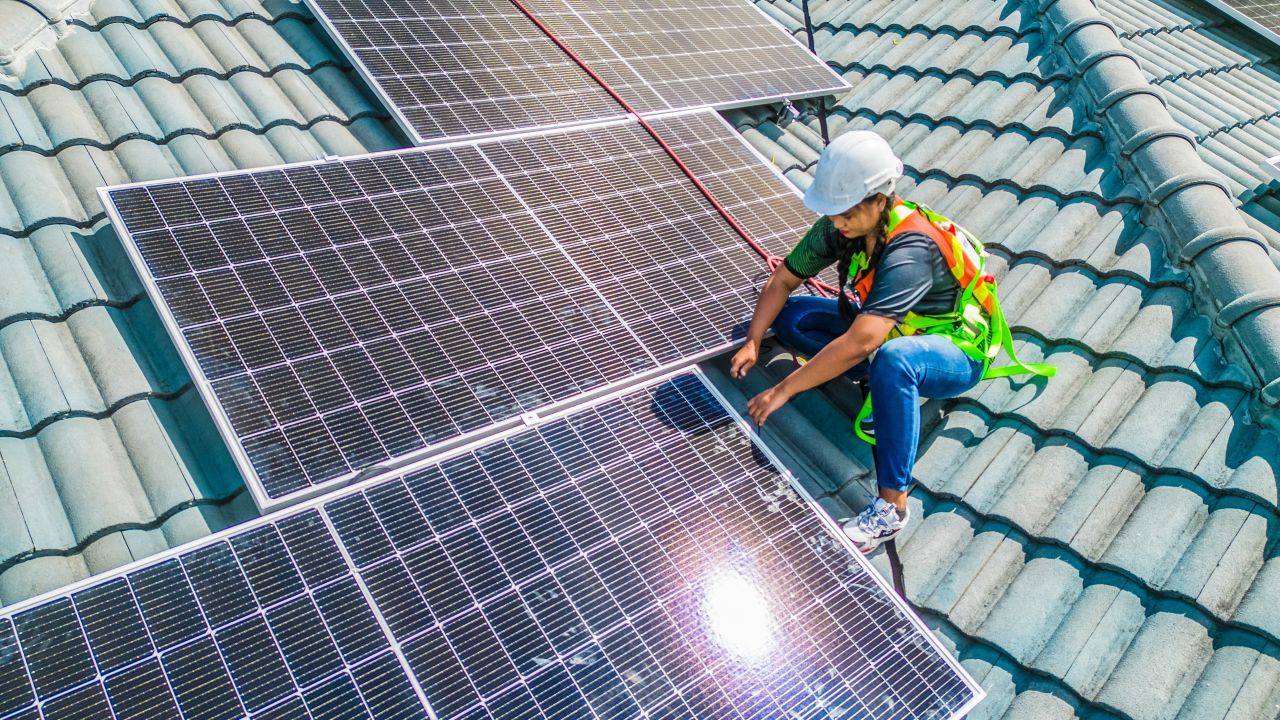
By integrating environmental sustainability into their business, women entrepreneurs can become agents of change. Photo credit: ADB.
Three enterprises in renewable energy, low-emission transport, and circular agriculture talk about how deploying green technologies can cut costs, boost incomes, and reduce carbon emissions.
Green technologies are becoming more accessible and affordable. Advances in solar technology, for example, have lowered the cost of photovoltaic (PV) systems, increasing adoption by residential, commercial, and industrial users.
Yet, uptake among small businesses, including women-led enterprises, is still slow because of lack of knowhow and financing.
An ADB-supported webinar on 6 October, the third of a series on women eco-entrepreneurship in Southeast Asia, focused on practical, market-ready technologies that women entrepreneurs and nano, micro, small, and medium-sized enterprises can use to improve operational efficiency while contributing to decarbonization. Resource speakers from the region talked about real-world applications, benefits, and lessons learned from deploying low-emission technologies in business operations. April Ong Vaño, head of environmental, social, and governance at Quest Ventures, moderated the discussions.
Agents of change
“Southeast Asia's fast growing and emerging green economy is projected to generate upwards of 30 million green jobs,” said Claire Charamnac, social development specialist (gender and development) at ADB, in her opening remarks. “To benefit from this growth, women entrepreneurs need support to overcome longstanding barriers related to formalizing their businesses, productivity, profitability, and financing. They also need to strengthen their capacity to adopt sustainability principles in their business models and operations.”
More than 60 million women run micro, small, and medium-sized enterprises in Southeast Asia. Green technologies can help them reduce cost, improve productivity, create business opportunities, and strengthen resilience against shocks. By integrating environmental sustainability into their business, women entrepreneurs can become agents of change.
Women-led enterprises and small businesses are well placed to lead the low-carbon transition, said Zhengzheng Qu, program management officer at the United Nations Environment Programme (UNEP).
Women are often in sectors where decarbonization matters, such as agriculture, food processing, retail, and waste management and recycling. “Yet they often face real barriers—limited access to information and knowledge, trusted suppliers, and technical support. They have difficulties in obtaining finance and constraints on asset and collateral, time, and network,” she said.
Nano enterprises, which are home-based or run by solo entrepreneurs, together with micro, small, and medium-sized enterprises are the backbone of economies in Southeast Asia.
“They create jobs. They drive local innovations collectively,” said Qu. “They also use a great deal of energy and materials and generate significant emissions. When thousands of small businesses make better choices, the cumulative impact is substantial.”
Market-ready solutions
The workshop featured three enterprises in renewable energy, low-emission transport, and circular agriculture.
Smart Solar has developed a subscription business model that enables households and businesses in Viet Nam to install rooftop solar systems with minimal upfront cost.
One out of five small and medium-sized businesses are owned by women in the country, said Linh Dau, growth lead at Smart Solar. “That is a very important group when we talk about the energy transition.” However, some entrepreneurs are not ready to invest in a solar PV system.
“Our solution is that we will invest in the system for you. We will design it, handle the legal process (e.g., obtaining permits), and operate it,” she said. “The business will simply use the solar electricity from their roof and pay for electricity at a lower rate than what they are buying from the grid.” She said the subscription model enables businesses to shift to solar energy to reduce electricity cost and carbon emissions without the “technical and financial headache.”
Smart Solar’s energy management system provides real-time tracking of solar energy production to help clients manage their monthly energy expenses and monitor how much carbon emissions were offset.
Linh advised enterprises that are considering a rooftop solar setup to assess how much electricity they consume during the daytime to determine their potential savings before making a decision. They also need to check the condition of their roof and the available space. Then they should explore financing options.
Onion Mobility, an electric vehicle (EV) manufacturing and battery infrastructure company in Cambodia, makes three wheelers or electric tuk-tuks and motorbikes, which are used by commuters and ride-hailing and delivery services.
Sokkheng Kaing, head of business operations at Onion Mobility, said sales were slow at the start because people did not know much about EVs. The company offered test drives to gain potential buyers’ trust in their products. Rising fuel prices helped boost sales. Women also found the three wheelers easier to handle than the manual transmission tuk-tuks.
She said most of their customers are small and medium-sized enterprises in retail logistics, food and beverage, cleaning services, and hospitality business. Shifting to EVs save them up to $300 a month in fuel savings for the electric tuk-tuk and up to $70 per month for the electric motorbike.
Onion Mobility also put up battery swapping stations that allow customers to exchange a depleted battery with a fully charged one in less than 5 minutes. Charging time for batteries take 3 to 4 hours.
The company works with local banks to offer vehicle financing to customers. It also offers a rent-to-own program, which appeals to buyers who find it difficult to get a bank loan.
HUSK Ventures, a social enterprise that operates in Cambodia and Viet Nam, transforms agricultural waste, including rice husk, into organic biochar, carbon-based fertilizer, and biopesticides using pyrolysis, which heats organic material without burning or smoke. Recoverable heat from the process is used to dry fertilizers.
Biochar is a highly porous, charcoal-like material that can improve soil fertility, crop yields, and farm incomes. It also draws carbon from the atmosphere.
Reksa Sangvat Nil, country director for Cambodia at HUSK Ventures, said the company brings “soil health, crop nutrition, energy recovery, and carbon storage into one business model.” It seeks to change the mindset of farmers and promote regenerative agriculture practices.
He said understanding the unique needs of farmers is key to the success of their business. “We manufacture and market products designed for different crops and growth stages. A rice farmer and a vegetable grower have different needs.” The company also offers different credit terms based on the harvesting cycle, giving vegetable growers a payment period of 60 days and rice farmers, 90 days.
With the use of biochar products, he said farmers see an average yield increase of 38% to 40% and profit increase of 45% to 50%.
Husk Ventures plans to expand its operations by working with agricultural and industrial enterprises that generate excess biomass and want to produce biochar on their own site.
In adopting green technologies, the resource speakers advised business owners to first find out how the technology or solution can create value in their business, such as by lowering cost or boosting efficiency. They could start small to test its impact and improve implementation with the help of feedback from customers. Learning and collaboration are part of the process.
The five-part Propelling Women Eco-Entrepreneurship into a Sustainable Future webinar series is a collaboration between the UNEP, UN Women, and ADB’s Gender Equality Division and Southeast Asia Development Solutions (SEADS). It is supported by the Governments of Germany, New Zealand, Sweden, and Switzerland through the EmPower: Women for Climate-Resilient Societies (EmPower) Programme, a joint effort between UN Women and UNEP.