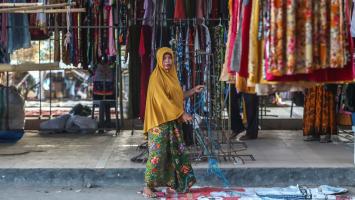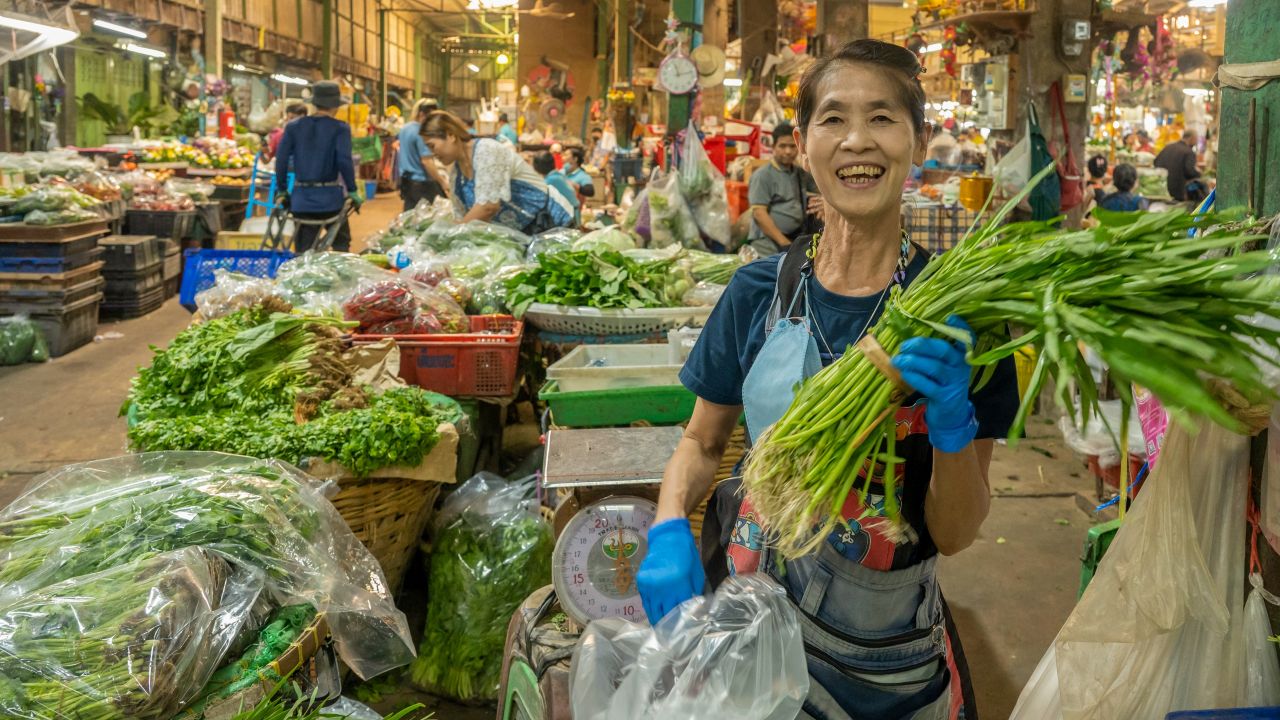
Across Southeast Asia, there are more than 60 million women who run micro, small, and medium-sized enterprises (MSMEs). Photo credit: ADB.
Women play an important role in driving inclusive low-carbon development.
Women entrepreneurs are a growing force in Southeast Asia with the potential to accelerate a just transition to a more resilient economy. By improving their access to finance, knowledge, and networks, women can make their businesses more sustainable. They also gain better access to opportunities from a green economy.
A recent webinar, the second of a series on women eco-entrepreneurship, discussed how innovative financing solutions can unlock capital for women-led businesses.
Financing models and services tailored to women eco-entrepreneurs can “both scale up climate action and also make it more inclusive,” said Sudhir Sharma, Regional Sub-Program Coordinator for Finance and Economic Transformation at the United Nations Environment Programme (UNEP), in his opening remarks.
Across Southeast Asia, there are more than 60 million women who run micro, small, and medium-sized enterprises (MSMEs). Many of these businesses are in the informal sector and are highly vulnerable to climate shocks, such as smallholder farming and tourism. This underscores the important role of women in driving inclusive low-carbon development.
Access to finance is a critical enabler for women eco-entrepreneurs, said Chieko Yokota, a gender specialist at ADB. “Many face persistent barriers in securing capital, including gender barriers, lack of collateral, and lack of financial products that meet their demands.”
Inclusive solutions
The webinar featured speakers from financial service providers from Indonesia, Thailand, and Viet Nam that cater to women. A sustainable finance expert also talked about ADB’s Women’s Finance Exchange and shared research in the Lao People’s Democratic Republic (Lao PDR), which shows how financial institutions can empower female entrepreneurs in sustainable sectors.
Aria Widyanto, Chief Risk and Sustainability Officer at Amartha Financial, related how the Indonesian fintech company developed a hybrid model for women-led ultra-microbusinesses in rural areas where there are low levels of financial and digital literacy.
Amartha operates a fully digital peer-to-peer lending platform, yet it has field officers to address the concerns of new customers and understand their needs. This close interaction with clients helped the company design targeted products and expand its portfolio from microloans to digital payments and micro-investing.
“We help our customers build a ladder toward financial health,” Widyanto said, by enabling them to grow their business and save and invest money. The company also plans to offer micro-insurance products.
Amartha uses an alternative credit scoring system to evaluate potential borrowers. Like other fintechs, it looks at digital footprints and alternative transaction histories to find out potential capacity and willingness to repay. In the absence of credit history, “we use behavioral data, telco data, and sometimes group dynamics information,” he said.
The company is also integrating artificial intelligence (AI)-powered credit scoring into its operations, with machine learning models drawing on more than 800 variables, including payment history and digital behavior, to assess borrower risk more accurately.
In Thailand, Muangthai Capital Public Company Ltd. is a nonbank financial institution that provides working capital loans to underserved informal workers and self-employed individuals with limited or no credit backgrounds or records with the National Credit Bureau and to micro and small enterprises. More than 90% of clients reside outside of Bangkok, and 55% are female.
Parithad Petampai, Chief Executive Officer of Muangthai Capital, said women-led eco-enterprises often have seasonal income. These include those engaged in organic farming, handicrafts making, and ecotourism. They have little or no assets to use as collateral to secure bank loans. They lack understanding of banking services and have low confidence in using technology.
Muangthai also uses both offline and online channels (mobile app and social media) to reach and serve customers. It has a network of more than 8,000 branches across the country.
The company offers flexible terms that enable women entrepreneurs to get a loan, said Petampai. “We accept motorbike as a collateral, but we only keep the document of the motorbike, and the motorbike can be 20 years old. The women can go home with their motorbike and use the motorbike in their business, so it won't interrupt their income.”
Women are encouraged to visit the nearest Muangthai branch to get more information on available products and services as well assistance in using the mobile app on their phone. “Most of our customers don’t have their data online,” he said. “We take their information” to build a credit history, which can be used for future loans.
Innovative products
Nguyen Thi Kim Phuong, Branch Director of the Bank for Investment and Development of Vietnam (BIDV), said the bank adopted a dual-approach strategy to overcome women’s financial barriers. It focuses on both providing capital to women-led small and medium-sized enterprises (SMEs) and building their capacity.
For this market, she said “we prioritize a cash flow-based lending product, where the assessment is focused on the business model, viability, and a predictable revenue stream.”
With technical assistance from ADB, BIDV also set up a supply chain finance system for SMEs, including women-led businesses. “It utilizes a validated transaction and contract with the credible anchor firm as an effective collateral substitute,” she explained.
Unlike traditional risk assessments that focus almost exclusively on financials and collateral, supply chain finance focuses its assessment on the strength and longevity of a supply chain, and the mutual dependence between buyer and supplier.
Through a strategic partnership with ADB and the Women Entrepreneurs Finance Initiative (We-Fi), Nguyen added that BIDV is able to develop and offer targeted green loan packages with a preferential interest rate for women eco-entrepreneurs, in support of Viet Nam’s sustainable development agenda.
Hosted by the World Bank, We-Fi is a partnership between 14 governments, eight multilateral development banks (MDBs), and other public and private sector stakeholders.
Balancing risks and opportunities
Carola Menzel, a sustainable finance expert, talked about how ADB’s Women’s Finance Exchange (gWFX) is assisting financial institutions in providing gender-responsive and sustainable finance. The program offers capacity building, funding and co-financing to boost lending to women, guidance on cutting-edge technologies, and knowledge support.
Menzel underscored the importance of data in making informed decisions. “Financial institutions need to scale up technical solutions to gather data, collect them, and work with such data to identify the needs of women and to also assess the risk and opportunities,” she said.
Insights from the Lao PDR study showed that there is a need to look into not just financial institutions but also the wider ecosystem, Menzel said. “We need to also speak to the regulator of the financial sector. We need to have guarantees in place,” she said. Risk-sharing instruments, such as guarantees and insurance products, can lower the cost of borrowing for financial institutions and improve their participation in green lending.
The Propelling Women Eco-Entrepreneurship into a Sustainable Future webinar series is a collaboration between the UNEP, UN Women, and ADB’s Gender Equality Division and Southeast Asia Development Solutions (SEADS). It spotlights the transformative role of women in driving sustainable development.
The webinar series is co-organized with ADB under the EmPower: Women for Climate-Resilient Societies (EmPower) Programme, a joint effort between UN Women and UNEP, supported by the Governments of Germany, New Zealand, Sweden, and Switzerland.