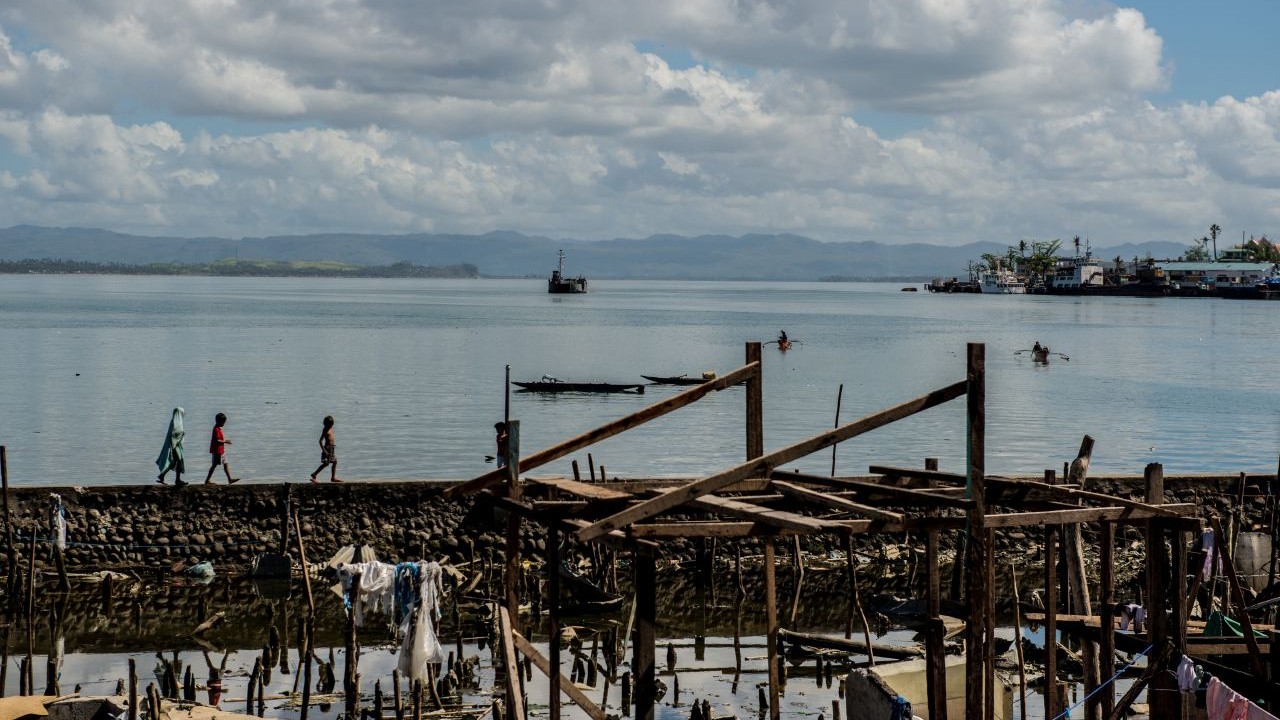
Flooding, storm surge, and other coastal hazards threaten lives and livelihoods and cause damage to property. Photo credit: ADB.
Rising seas and intensifying coastal hazards endanger communities and disrupt economic activities.
Coastal areas are often engines of economic growth. They serve as hubs for trade, industry, and connectivity.
In Southeast Asia, which has one of the world’s longest coastlines, coastal cities are home to more than 70% of the population. Their ports and logistics infrastructure link producers with international markets. Fisheries, aquaculture, and coastal and maritime tourism provide jobs and sustain local economies. In some countries in the region, coastal areas account for more than 60% of the gross domestic product.
Coasts, however, are particularly vulnerable to disasters. Coastal hazards, such as flooding, storm surge, marine heatwaves, erosion, and salinity intrusion, pose serious threats to human health, cause damage to infrastructure and property, and disrupt economic activities. Flood damage alone is estimated at about $11.5 billion a year in Southeast Asia.
ADB’s assessment of coastal hazards and risks in Asia and the Pacific suggests escalating pressure on coastal systems due to rising seas and intensifying hazards. In addition, the concentration of critical infrastructure in flood-exposed areas “locks more people and assets into harm’s way with each passing year.”
In major coastal cities, such as Bangkok, Jakarta, Kolkata, and Mumbai, coastal floods that historically occurred once every 100 years could become annual events by the end of the century. Without adaptation measures, annual coastal flood damages in Asia and the Pacific could increase more than sixfold by 2050 and nearly twentyfold by 2100.
“We are at a turning point and must act now with long-term, adaptive, and risk-informed solutions to create resilient coasts that keep people safe and economies running,” says Director General of ADB’s Climate Change and Sustainable Development Department Yevgeniy Zhukov.
Rising health risks
More frequent and severe hazards are raising health costs across the region, says the report. Women, youth, Indigenous Peoples, and low-income households are often hit the hardest because of limited capacity to adapt and recover.
Saltwater intrusion raises hypertension and pregnancy complications. Vector-borne diseases, such as dengue, thrive in extreme heat and high humidity. Heavy rainfall and flooding also create favorable conditions for the spread of disease.
Coastal flooding, storms, and saltwater intrusion also affect water supply, wastewater, sanitation, and solid waste systems. The breakdown of critical infrastructure has serious impacts on public health, labor productivity, and local economies.
Warmer seas and accelerating acidification have reduced fish stocks and seafood quality, affecting food security and nutrition. Saltwater intrusion into groundwater sources increases arsenic exposure. “In parts of South and Southeast Asia, arsenic in drinking water is already a major public health risk, and long-term exposure is linked to bladder, skin, lung, and liver cancers,” says the report.
Benefits far exceed cost
Investing in resilience could produce benefits up to 20 times greater than the capital required. The report says “coastal resilience is not a cost imposed on the region’s growth but a condition for sustaining it.”
Southeast Asia contains the largest extent of coral reefs and mangroves, which provide critical habitat for marine life and protect communities from erosion, flooding, and sea level rise. The region produces about one-fifth of the world’s fisheries and aquaculture output.
“Disruption [caused by coastal hazards] raises trade costs, interrupts the value chains that coastal manufacturing depends on, and puts investors off, while the erosion of reefs and beaches reduces tourism revenues on which several economies in the region depend,” says the report.
Bridging the financing gap
While international adaptation finance to coastal economies in Asia and the Pacific roughly doubled to an average of $11.4 billion a year in 2022–2023 from about $5 billion in 2015, a large financing gap remains.
“Costed adaptation plans available for 15 coastal developing member countries indicate short- term adaptation financing needs of about $20 billion a year—about 1% of GDP—but these estimates cover only about half of coastal developing member countries (DMCs), exclude the People’s Republic of China and India, and are not limited specifically to coastal resilience,” says the report.
Closing the gap will require expanding fiscal space and mobilizing additional public, private, and concessional finance for long-term resilience investments.
“Adaptive planning can help sequence domestic resource mobilization, public financial management measures, and financing instruments over time, while policy and regulatory reforms can help unlock greater private sector participation,” says the report.
Regional cooperation can also “help countries overcome fragmented financing landscapes as well as capacity constraints, limited economies of scale, and high transaction costs.”
Initiatives include the Coalition of Finance Ministers for Climate Action, a global alliance of fiscal and economic policymakers from over 90 countries, including ASEAN member countries. The coalition advances the integration of climate resilience into economic and fiscal decisions.
The ASEAN Climate Finance Policy Platform (ACFPP) is an ADB-supported regional initiative that brings together Ministries of Finance across Southeast Asia to strengthen policy frameworks, build institutional capacity, and mobilize finance for climate action.
In September, ADB announced it will mobilize up to $6 billion through 2030 to strengthen the ASEAN blue economy. The financing initiative includes building resilient coastal infrastructure.
The Southeast Asia Disaster Risk Insurance Facility (SEADRIF) is a regional risk-pooling facility that support ASEAN member countries.

