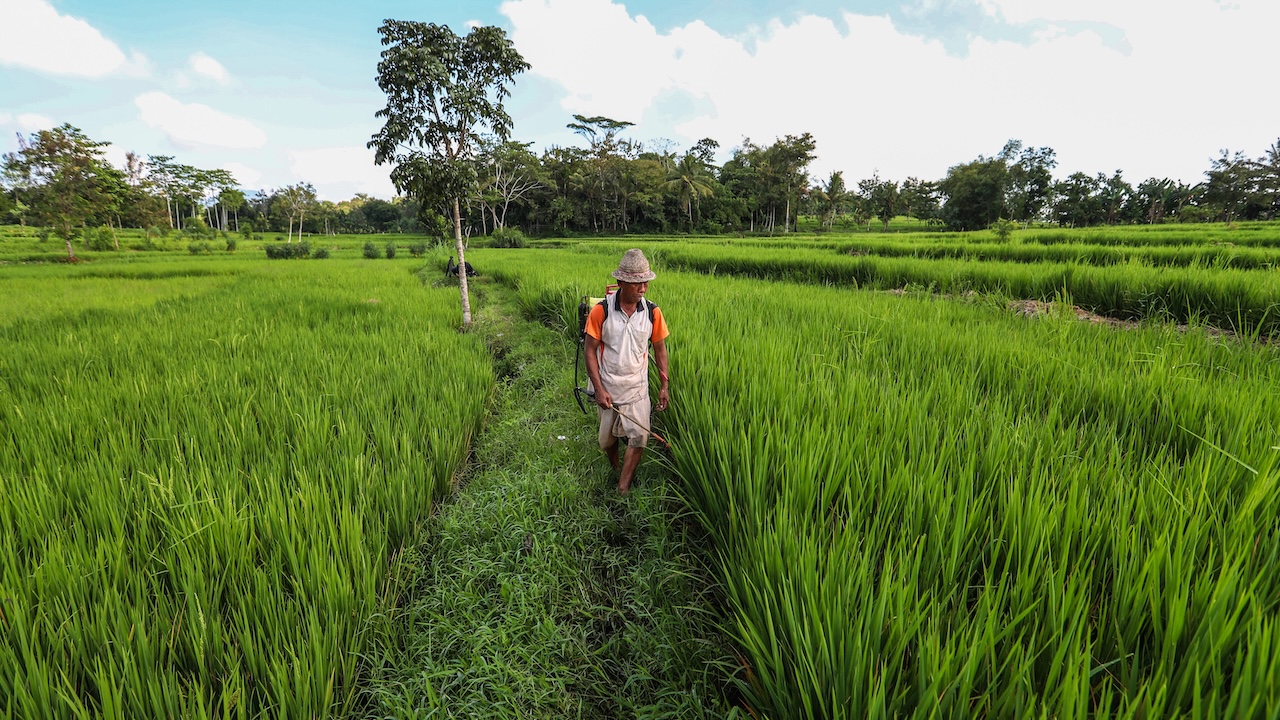
Indonesia’s food systems transformation is a central pillar of its efforts to achieve the Sustainable Development Goals. Photo credit: ADB.
Sustaining the gains of Indonesia’s agrifood transformation journey would require strengthening the system linkages to make existing programs work effectively.
In the face of growing demand for food, Indonesia has elevated food security to a national priority. Along with rising population, intensifying risks from climate change and environmental degradation underscore the country’s urgent need for sustainable and resilient food systems.
At the recent Asia and the Pacific Food Systems Forum 2026 organized by the Asian Development Bank (ADB), speakers highlighted pathways for strengthening the productivity, efficiency, and resilience of the agrifood sector. A deep-dive session on Indonesia showcased the country’s holistic policy approach to food systems transformation, a central pillar for its achievement of the Sustainable Development Goals.
“Indonesia’s vision for food systems transformation very closely aligns with ADB's own approach, which covers five dimensions: better nutrition, modernizing value chains, strengthening natural capital, resilient infrastructure, and of course, inclusive livelihoods,” said ADB Senior Director Qingfeng Zhang.
Despite Indonesia’s progress in bolstering its self-sufficiency in production, several challenges remain. Current agricultural practices and land use changes are compromising natural resources, which form the foundation of the agrifood sector. In addition, the sector is characterized by insufficient diversification, resulting in significant reliance on imports. The dominance of staples in agricultural production has limited access to diverse and nutritious foods, which are generally considered unaffordable for a significant number of Indonesian households. Also critical to address are the gaps in connectivity and logistics that not only bring inefficiencies and high costs to the distribution of food supplies across several islands in Indonesia but also contribute to food losses.
“One key take away is that Indonesia's food system challenge is not [only] about producing more food, but [also] about delivering healthier, safer and more affordable diets across a very complex archipelago,” said Global Alliance for Improved Nutrition Head of Programs for Indonesia Widya Sutiyo.
Strengthening the institutional underpinnings of Indonesia’s agrifood system is equally important given its interconnected and multisectoral nature. Enhancing coordination, leveraging data for evidence-based decisions, and boosting capacities are crucial to effectively implement measures and shape meaningful outcomes.
“Outcomes heavily depend on coordination,” Widya Sutiyo emphasized. “Strengthening the system linkages is important to make existing programs work better together.”
Ministry of National Development Planning/Bappenas Director for Food and Agriculture Jarot Indarto also highlighted the importance of systematic coordination to foster synergies in driving solutions across Indonesia’s food value chains. He underscored the need for regional and cross-institutional collaboration, boosting innovation and research, and integrated efforts across the public and private sectors, research institutions, development partners, and civil society to promote mutually reinforcing approaches in transforming the country’s complex agrifood systems.
Recipes for Change
Given the growing imperative of reducing the impact of conventional agricultural practices, Indonesian farmers have begun adopting measures for sustainable crop cultivation. For instance, techniques are being applied in rice production that optimize resource management while improving soil health and reducing carbon emissions. Efforts have also focused on expanding the availability of nutrient-rich crops produced locally through diversification.
Beyond agricultural production interventions, Indonesia is focused on boosting the nutritional adequacy of Indonesian diet through the Makan Bergizi Gratis (MBG) or Free and Nutritious Meals program. Launched in 2025, MBG program aims to create a virtuous cycle where local farmers produce nutritious food and secure a stable market while students gain access to healthy meals. The benefits of the program are multifaceted—it not only improves the health and nutrition of students and other beneficiaries but also has broader economic impact by supporting the livelihoods of local farmers and creating jobs for workers in the food and transport industry.
“With this program, we can also create jobs... We [have] already built so far 25,000 central kitchens all across Indonesia,” said Indonesia Coordinating Ministry for Food Affairs Director Sabbat Christian Jannes said at the forum held on 17 March. To date, there are almost 62 million MBG beneficiaries and more than 1 million personnel working for the program, he said during the forum.
While all these initiatives are advancing Indonesia’s food systems transformation agenda, bridging financing gaps in the agriculture sector is key to sustaining the country’s momentum. The Kredit Usaha Rakyat (KUR) or People’s Business Credit program has been designed to provide low-interest, government-subsidized loans to increase Indonesian farmers' access to capital. ADB is currently studying how KUR can be extended to climate-smart agriculture given the limited finance instruments for climate adaptation in this sector.
Possibilities are also being explored to determine funding sources for KUR in the future since it cannot solely depend on government subsidies in perpetuity. One option is to engage private banks in the KUR scheme with the aim of transitioning the program toward commercial sustainability. ADB Senior Adaptation Solutions Specialist Nanki Kaur noted, “the idea is to look at smart subsidy, which is more targeted, and then focus much more on the macroprudential instruments that would incentivize banks to start taking this on as a scheme that they would finance themselves.”
A Key Ingredient: Unlocking Private Sector Participation
While the private sector plays an integral role in building sustainable food systems, an enabling environment is a prerequisite to scale up their engagement. Policy predictability is integral to attracting private capital as it reduces regulatory risk, thereby enabling investors to commit to projects. ADB Senior Investment Specialist Valtter Louhivuori stressed, “policy consistency or predictability is a number one thing for long-term planning.”
The private sector also acts as a vital source of funding and insurance products that are essential for managing climate risks. However, lack of protection for land rights hinders farmers’ ability to provide collateral for accessing financing instruments. Therefore, strengthening land tenure security and property rights should be accelerated to reduce farmers’ vulnerability and help them obtain credit necessary to improve their productivity.
Finally, enhancing value chain integration is a critical area where private investments can act as a catalytic force by providing the necessary capital, technology, and market linkages to connect local producers with global markets, improve efficiency, and foster sustainability. But due to perceived lack of bankability of agricultural projects, blended capital can be utilized to improve risk-return profiles, making high-risk projects attractive to commercial investors. Valtter Louhivuori said, “we can help de-risk those investments and work with both private companies as well as the public sector for a more sustained and long-term trajectory for food systems transformation in Indonesia in a predictable way.”