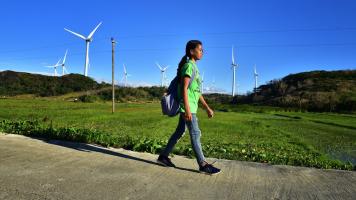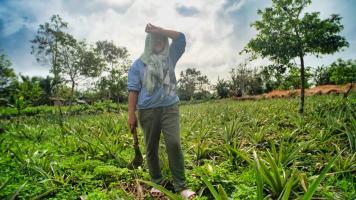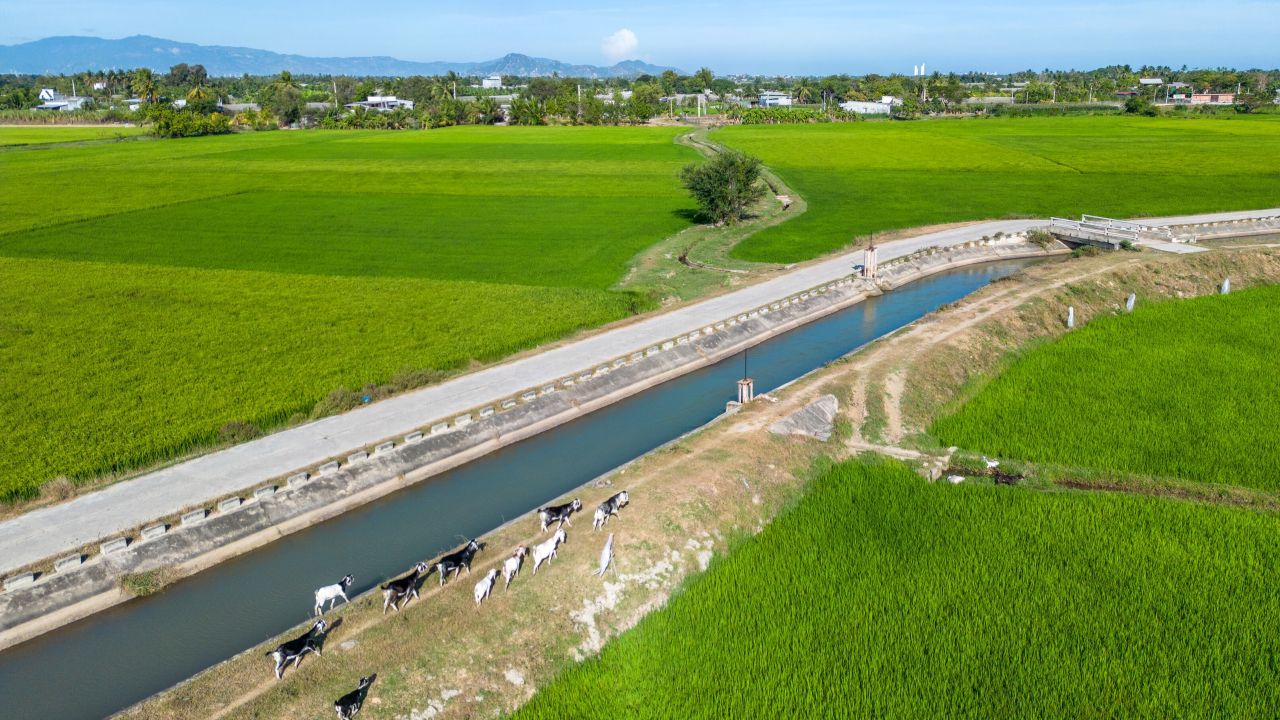
The latest version of the taxonomy includes Version 4 includes the technical screening criteria for the three remaining focus sectors—agriculture, forestry, and fishing; manufacturing; and water supply, sewerage, and waste management. Photo credit: ADB.
A comprehensive, science-based taxonomy will help businesses, project proponents, and investors understand what would qualify for sustainable financing.
For the past 5 years, ASEAN has been a top recipient of foreign direct investments. Opportunities from deeper regional integration and the restructuring of global supply chains are largely driving the surge in inflows. Climate and transition finance is increasing, but investments to support sustainable development have been sluggish overall.
The economic bloc of 11 Southeast Asian countries faces a wide gap in sustainable investments. Public finance alone cannot shoulder required investments in climate-resilient infrastructure, estimated by ADB at $210 billion per year. Half of the amount will need to come from private, institutional, and commercial financing sources and through innovative finance mechanisms. A 2025 report by Bain & Company, GenZero, Google, Standard Chartered, and Temasek estimates the shortfall for meeting critical emission targets by 2030 at $50 billion annually. Meanwhile, the global slump in international project finance, which started in 2023, has affected infrastructure, utilities, and renewable energy development in ASEAN, where the value of deals suffered a 50% decline in 2024.
To get on track to meet its goals, ASEAN has to double down on efforts to compete for funds in the global arena. This makes the completion of the ASEAN Taxonomy for Sustainable Finance (Version 4) last November timely. The purpose of a comprehensive, science-based taxonomy is to help businesses and project proponents understand what would qualify for sustainable financing and to assist investors’ decision making by providing clear guidance and criteria to assess the sustainability of projects. Here are five things to know.
1. The ASEAN Taxonomy is designed as a flexible and inclusive framework.
The ASEAN Taxonomy is the regional reference framework for classifying sustainable economic activities, including climate adaptation projects, and for guiding capital and funding toward these activities. It provides a common language to harmonize and complement national sustainability initiatives.
With technical assistance from ADB, the taxonomy was developed by the ASEAN Taxonomy Board, which was set up under the guidance of ASEAN finance ministers and central bank governors. Version 4 is the product of a multi-year, multi-stakeholder effort that began in 2021.
The taxonomy is designed for the diverse economic, social, and developmental needs of ASEAN member states, moving away from a "one-size-fits-all" approach to a more flexible, inclusive framework. This provides different starting points and pathways toward an orderly and just transition to a low-carbon and climate-resilient future.
A multi-tiered approach was used to allow for different levels of adoption, depending on a country’s readiness.
In a write-up for the Asia Bond Monitor, Eugene Wong, chief executive officer of the Sustainable Finance Institute Asia, explains that the ASEAN Taxonomy is “multi-tiered in two ways.” It has a principles-based Foundation Framework and a technical screening criteria-based Plus Standard. This provides countries with the option of using either framework to assess an economic activity.
“The second is that each economic activity under the Plus Standard can have up to three performance thresholds, allowing users to start with a tier that is practical for them. This is different from taxonomies that only have one threshold, resulting in an activity being either aligned or not aligned with the relevant taxonomy,” he says.
Plus Standard thresholds are sector-specific quantitative limits introduced to determine whether a project will qualify under the taxonomy or not.
2. The taxonomy incorporates transition activities, particularly for hard-to-abate sectors.
Both the Foundation Framework and Plus Standard use a “traffic light” system with three categories—green (sustainable), amber (transitioning), and red (ineligible).
Transition activities or projects are necessary for hard-to-abate sectors, such as the power and industry sectors, which are the largest sources of emissions in Southeast Asia and where there is a lack of commercially viable or cost-effective low-carbon solutions. These activities can help countries shift these sectors to a sustainable path and eventually achieve decarbonization targets.
Version 2, released in 2023, added coal phaseouts as a transition activity, making the ASEAN Taxonomy the first to include technical screening criteria for the early retirement of coal plants. Coal-fired power generation is still a major source of electricity in the region. Many of the plants are relatively young, averaging less than 15 years old.
The ASEAN Taxonomy also includes remedial measures to transition as an essential criterion for classification. It requires that any significant harm resulting from an activity is either removed or mitigated within a specific time period.
3. Version 4 includes agriculture, forestry, and fishing; manufacturing; and water supply, sewerage, and waste management.
The Plus Standard covers six economic sectors, which contribute to 85% of the greenhouse gas emissions in the region. It also includes three enabling sectors that support the taxonomy’s environmental objectives.
Earlier versions of the taxonomy provided the technical screening criteria for three of the focus sectors—electricity, gas, steam, and air conditioning supply; transportation and storage; and construction and real estate; and one enabling sector—carbon capture, storage, and utilization as an enabling sector.
Version 4 includes the technical screening criteria for the three remaining focus sectors—agriculture, forestry, and fishing; manufacturing; and water supply, sewerage, and waste management; and two enabling sectors—information and communication (includes data centers); and professional, scientific, and technical activities.
The ASEAN Taxonomy is the first to introduce technical screening criteria for fishing, using references that are internationally recognized and frameworks developed at the regional level.
4. The taxonomy aligns with national and global frameworks.
The ASEAN Taxonomy is designed to work with widely used international taxonomies, such as the European Union Taxonomy for Sustainable Activities (EU Taxonomy) and the Climate Bonds Taxonomy, which was developed by the Climate Bonds Initiative. The Plus Standard’s green tier is largely aligned with the EU Taxonomy.
Developers of the national taxonomies of ASEAN member states are represented in the ASEAN Taxonomy Board. This has promoted interoperability and alignment with official taxonomies of Indonesia, the Philippines, Singapore, and Thailand. Other countries are in the process of developing national taxonomies, using a framework that is consistent with the regional taxonomy.
5. The ASEAN Taxonomy will be reviewed and updated periodically.
The ASEAN Taxonomy Board will continue to maintain and update the taxonomy, ensuring it remains responsive to technological, scientific, and market developments. The board will promote its adoption and conduct consultations with key stakeholders and users of the taxonomy.
In the meantime, the ASEAN Capital Markets Forum, which is a core member of the ASEAN Taxonomy Board, is working with United Nations Environment Programme Finance Initiative on a mitigation co-benefit and Adaptation for Resilience (mARs) Guide as a companion to the ASEAN Taxonomy. Its objective is to “enhance the functionality and usability of the taxonomy to channel adaptation finance.”
“Taxonomies have a very important role to play. Governments and markets must collaborate to ensure that they support, rather than fragment, the sustainability agenda. Eventually, taxonomy equivalence, not just interoperability, will be needed for effective and efficient capital orientation,” says Wong.