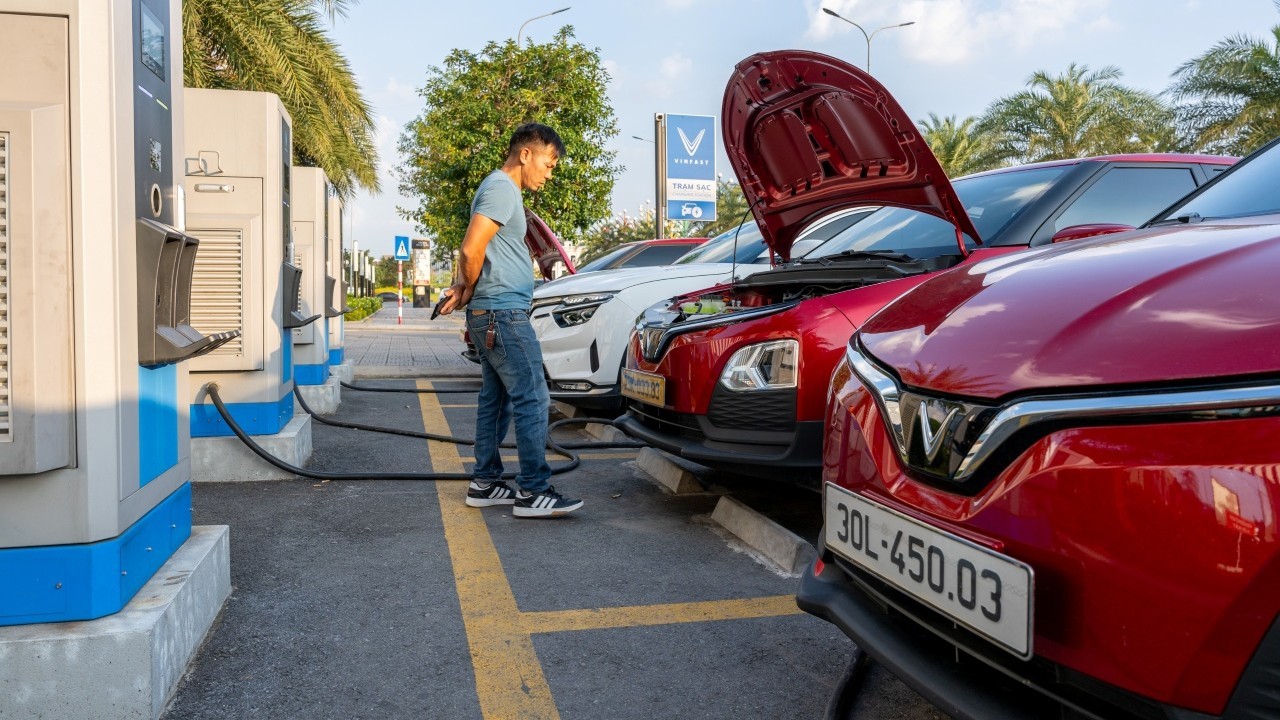
Several ASEAN countries now have among the highest electric vehicle sales penetration of any country in the world. Photo credit: ADB.
Emerging markets in the region are no longer catching up in adopting electric vehicles; they are leading the shift to electric mobility.
Southeast Asia is emerging as a new leader in electric vehicle adoption as supportive policies enable the region and other emerging markets to drive sales, says a new report from energy think tank Ember.
New markets in Southeast Asia and Latin America are rapidly switching to electric vehicles, joining Europe and the People’s Republic of China in boosting sales, and leapfrogging legacy auto markets in the process. “Growth in emerging markets has turbocharged global EV sales in 2025, with over a quarter of new cars sold being electric,” says the report.
The report examines the global electric vehicle landscape in 2025, analyzing available monthly data for 60 countries which made up over 97% of global electric vehicle sales in 2024. It focuses on the passenger car market and uses data for the first 10 months 2025.
In Southeast Asia, Viet Nam takes the lead as it doubles its electric vehicle sales share since 2024 to reach close to 40% in 2025, overtaking the United Kingdom (UK) and the European Union (EU). Thailand also advanced, surpassing 20% sales share for the first time as of October, up from 1% in 2019. Notably, Singapore, Thailand, and Viet Nam all posted higher battery electric vehicle sales shares compared to the EU average.
Leapfrogging to high shares
Across regions, multiple emerging markets are surpassing advanced economies. Several ASEAN countries now have among the highest electric vehicle sales penetration of any country in the world.
Close to 40% of Viet Nam’s new car sales as of October have been electric vehicles, almost all of them battery electric vehicles made by local manufacturer VinFast. It is now gaining ground on regional leader Singapore, where electric vehicle sales share has exceeded 40% of new car sales so far in 2025.
Viet Nam and Singapore now have higher levels of electric vehicle sales penetration than the UK (33%) and the EU (26%). Viet Nam’s rise is meteoric considering that in 2021, electric vehicle sales share stood at less than 0.05%.
In Thailand, electric vehicle sales share stood at 20%, with sales surpassing those of EU frontrunner Denmark in the first 10 months of 2025.
In Indonesia, electric vehicles have made up 15% of new car sales, topping the electric vehicle sales share in the United States for the first time. The market share for electric vehicles in US as well as Japan has remained at the same level for the last 2 years.
“This is a major turning point. In 2025, the center of gravity has moved. Emerging markets are no longer catching up; they are leading the shift to electric mobility. These countries see the strategic advantages of EVs, from cleaner air to reduced fossil fuel imports,” the report quoted Euan Graham, Ember electricity and data analyst, as saying.
The assumption that EV growth will stall outside Europe and the People’s Republic of China is already outdated, he says. “Emerging markets will shape the future of the global car market. The choices made now on charging infrastructure and early support will determine how fast this momentum continues.”
Supportive policies
The report says supportive policies enabled markets to leapfrog to high electric vehicle shares. Many emerging markets have introduced such policies as they view electric vehicles as a strategic priority to reduce fossil fuel imports, build new industries, and improve air quality.
For some countries, embracing electric vehicles brings the possibility of drawing investment in new industries and creating jobs.
In 2023, Indonesia introduced reduced value-added tax on sales of electric cars which met a certain threshold of local content requirement. It also temporarily cut import tariffs for manufacturers who committed to open manufacturing facilities in the country by 2026. As of May 2025, seven manufacturers had committed to setting up facilities, as well as Chinese battery manufacturer CATL.
In Viet Nam, VinFast initially built scale by selling directly to affiliate ride-hailing companies and building its own charging network, before successfully pivoting to the consumer market. As of October, three-quarters of its sales have been direct to consumers, with their flagship VF 3 being the best-selling car in the country in 2025. The World Bank has estimated that the EV industry could create 6.5 million jobs in Viet Nam by 2050.
Türkiye has introduced tax cuts for new electric vehicles, and made efforts to draw investments in EV manufacturing, including a new BYD manufacturing plant.
Electric vehicles are driving down fossil reliance, says the report. While conventional vehicles waste around 80% of the energy in the fuel, electric vehicles use close to 80% of the electricity they consume. This leads to large reductions in overall fossil fuel consumption even if a country’s electricity supply is heavily dependent on fossil generation. As a result, Viet Nam has seen a 63% decline in fossil fuel primary energy consumption, while Indonesia saw a 48% decrease.
The policy and consumer shift in emerging markets toward electric vehicles is a globally significant trend, bringing with it new leaders in transport electrification, the report says. It is also set to have profound impacts on future oil demand, with emerging markets set to make up the majority of new car sales between now and 2050. “Investment in charging infrastructure and policy mechanisms to support early adoption will be key in order for more markets to follow in the footsteps of these new leaders,” the report says.