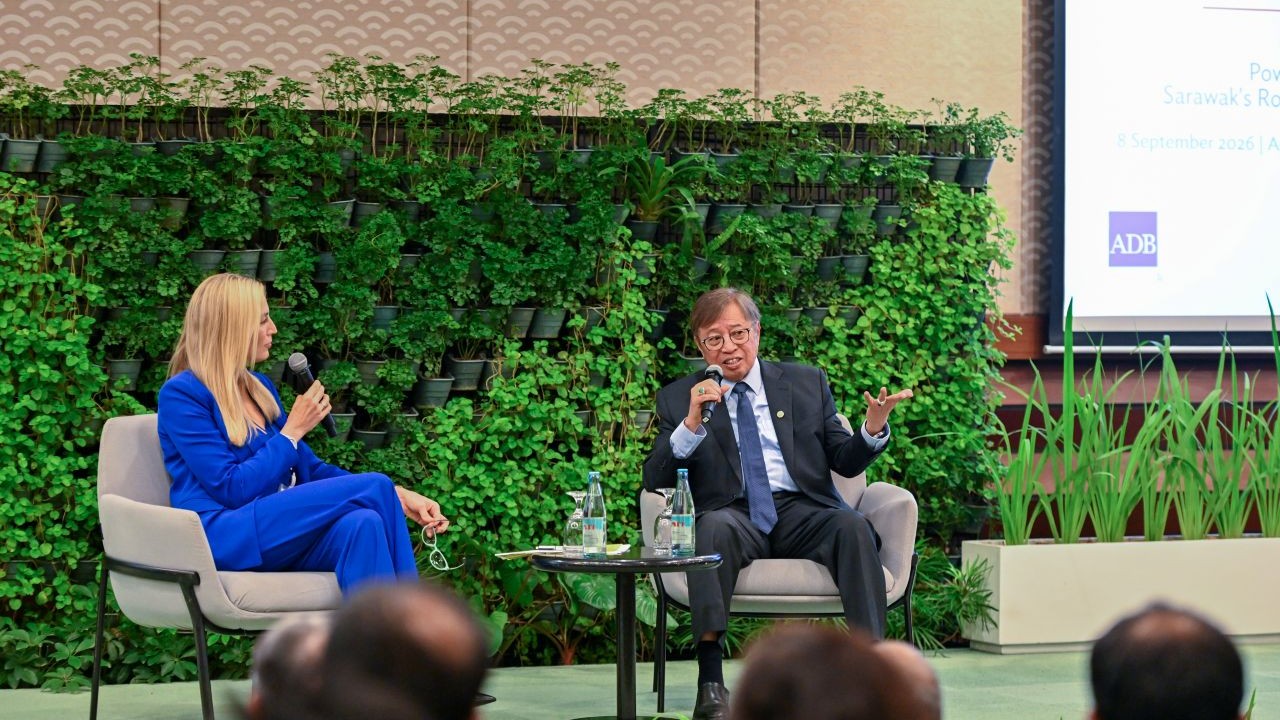
Datuk Patinggi Tan Sri Abang Johari Tun Openg, the Premier of Sarawak, outlined Sarawak's ambitious initiatives in energy, digitalization, transport, tourism, and human capital development during a fireside chat moderated by Susann Roth, advisor to the ADB Secretary and head of the Information Access Unit.
Malaysia’s resource-rich state is moving toward sustainable, inclusive, and higher value-added growth.
Datuk Patinggi Tan Sri Abang Johari Tun Openg, the Premier of Sarawak, shared the state’s vision of a diversified, green, and technology-driven economy during his visit to ADB headquarters on 8 September. Susann Roth, advisor to the ADB Secretary and head of the Information Access Unit, moderated the fireside chat.
The Premier is the highest executive authority of Sarawak, a state of Malaysia located in the northwestern part of the island of Borneo.
During the fireside chat, the Premier outlined Sarawak's ambitious initiatives in such areas as green energy, cross-border electricity and carbon trading, digitalization, transport, tourism, and human capital development to steer the resource-rich state toward sustainable, inclusive, and higher value-added growth.
Green energy
In energy, Sarawak is targeting 10 gigawatts of green power by 2030 and 15 gigawatts by 2035 and plans to increase their electricity exports. It currently supplies power to West Kalimantan, Indonesia through the cross-border power transmission line that ADB helped build. The state plans to also supply Brunei Darussalam in 2029, and it is exploring the possibility of exporting to the Philippines and Singapore.
The Premier believes that green energy is the solution to the climate crisis and a core driver of economic resilience and competitiveness in the face of carbon levies. He expects Sarawak’s investment in hydrogen development, which is currently costly, to result in high returns in the future as improvements in technology can bring down production cost and increase efficiency. The state’s hydrogen-powered autonomous rapid transit (ART) project serves as a demonstration platform for the viability of hydrogen.
Talking about the ASEAN Power Grid (APG), the Premier underscored the importance of connectivity. He has proposed for the establishment of a cable manufacturing company, either locally or in Indonesia, to address the shortage for undersea cables needed for regional connectivity. He said a good model for the APG is the European Union electricity market, where power has become a tradable commodity.
Other priority sectors
Another green initiative is developing a low-carbon hub in Kuching, the state capital. The plan includes decarbonizing air and maritime ports.
Sarawak is also promoting investment in high-technology manufacturing. The Premier cited the development of an ultra-high purity semiconductor-grade polysilicon in Bintulu, a joint venture of OCI Holdings of the Republic of Korea and Tokuyama Corporation of Japan.
Tourism is another priority sector. To improve air connectivity and boost tourism, the Sarawak state government has acquired MASwings, a subsidiary of Malaysia Airlines, rebranding it as AirBorneo. The Premier said the airline is another carefully calculated investment of the state, which is expected to advance long-term goals.
On human capital development, the Premier said: “I think, for us to move forward, talent is important. That is why I give free tertiary education.” The state provides free education for 10,000 students annually in STEM fields to build the skilled workforce required for a high-value economy.
Potential areas of support
During his visit, the Premier met with ADB President Masato Kanda to discuss regional connectivity, clean energy, and green finance. They discussed Sarawak’s role in the APG and ADB’s work to advance the APG. They also discussed the proposed Kuching Low Carbon Hub, an integrated port, energy, urban development, and industrial zone, and how ADB could support its masterplan, project sequencing, and financing. The Premier also met ADB Vice-President (Market Solutions) Bhargav Dasgupta and management of ADB’s Southeast Asia Department.
The Sarawak delegation included senior representatives from the Sarawak Financial Secretary’s Office, Economic Planning Unit (EPU) Sarawak, Sarawak Climate and Energy Diplomacy Unit (SACED), Sarawak Energy, Petroleum Sarawak Berhad (PETROS), and Development Bank of Sarawak Berhad (DBOS). They held technical meetings with ADB on the APG, the Hub, and green finance.