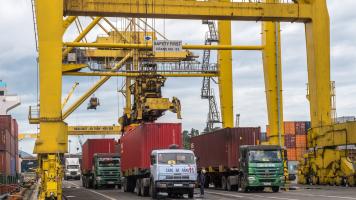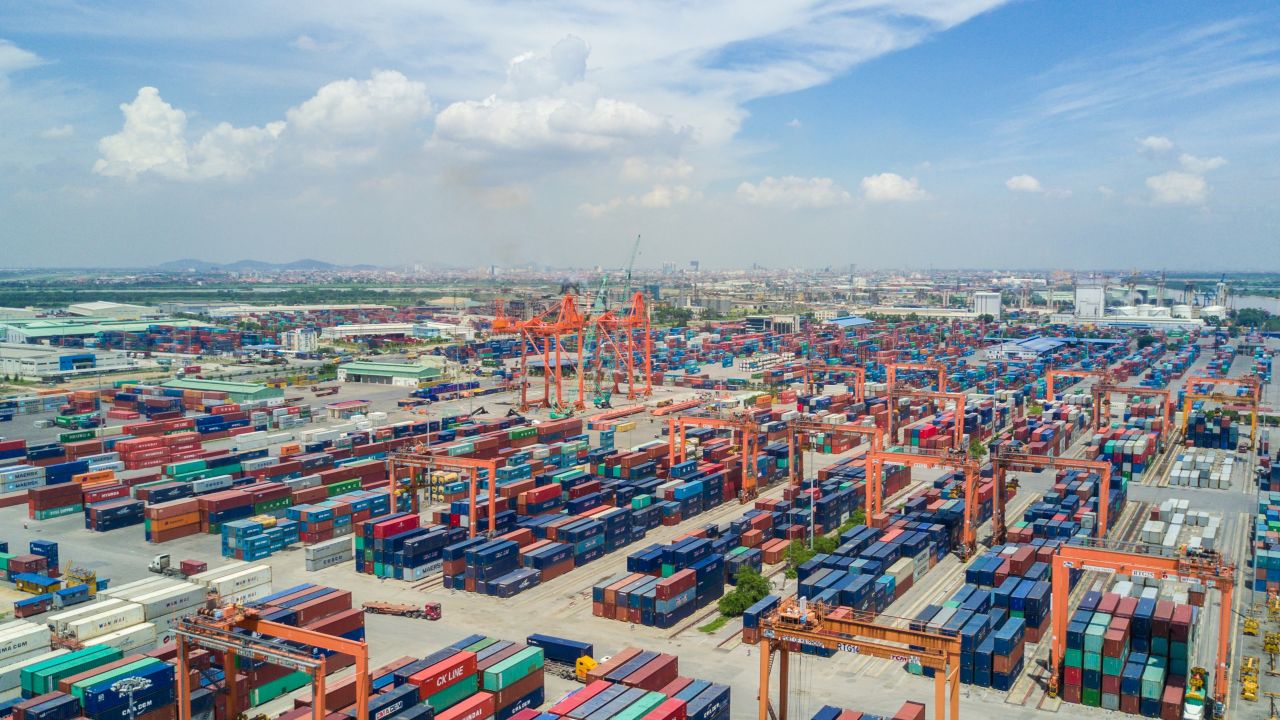
Cross-border paperless trade continues to advance in Southeast Asia with the expansion of the ASEAN Single Window. Photo credit: ADB.
Southeast Asia makes notable progress in transitioning to paperless trade.
Digitalization promises not only to make trade operations cheaper and faster through higher efficiency but also reduce supply chain vulnerabilities and strengthen economies against external shocks. Disruptions in global value chains due to the COVID-19 pandemic and other shocks underscore the urgent need for digitalization to enhance the resilience and sustainability of interconnected production networks.
Technologies, such as blockchain, can transform supply chains by making transactions transparent, traceable, and visible and by optimizing routes and cutting down idle time. Greater efficiency also enables freight and logistics operators to reduce carbon emissions.
Artificial intelligence (AI) is expected to improve trade facilitation exponentially. A study by the United Nations Economic and Social Commission for East Asia and the Pacific (ESCAP) and ADB finds that AI is increasingly being used in customs and logistics systems in Asia and the Pacific. Applications include automated verification of shipping documents, machine learning tools to identify high-risk cargo, and image analysis technologies used in border inspections. These help reduce delays, improve compliance, and strengthen supply chain resilience as economies face growing trade pressures, and more complex regulations.
However, despite growing interest in AI, most economies in the region have yet to deploy the technology at scale.
Paperless trade
According to a 2025 UN survey, the global trade facilitation implementation rate averaged at 71% last year, while the regional average for Asia and the Pacific was at 70%. Trade facilitation involves measures to simplify and digitalize trade processes.
In developing Asia, Southeast Asia had among the highest implementation rates at 83% in 2025, up from 79% in 2023. Cross-border paperless trade continued to advance with the expansion of the ASEAN Single Window and document exchange capabilities. The ASEAN Single Window enables the electronic exchange of certificates of origin and customs declarations.
The survey report notes that full implementation of digital trade facilitation measures can reduce trade costs by 7.5% for ASEAN. The regional bloc plans to expand the ASEAN Single Window to external trade partners, including the People’s Republic of China.
The signing of the ASEAN Digital Economy Framework Agreement at the 49th ASEAN Summit in November 2026 is expected to accelerate the transition to paperless trade and the digitalization of processes to expedite customs clearance, enhance security, and reduce trade transaction costs.
Meanwhile, the UN report stresses the need to broaden trade facilitation measures to address the needs of small and medium-sized enterprises and agricultural and women traders.
Adaptive technologies
AI-powered solutions are transforming trade processes across the world. In Asia and the Pacific, however, the deployment of AI in trade facilitation is at a nascent stage. According to the ESCAP–ADB report, AI implementation rate in the region stands below 15%, with levels ranging from 1% to 40% across subregions. East Asia leads in AI readiness across operational deployment, governance frameworks, and data quality, followed by Australia and New Zealand and Southeast Asia.
“Our region includes some of the world's leading countries and frontier AI model development. Yet, capabilities remain uneven across the region. We therefore need to consider not only what technology can do, but also what institutional foundations are needed for it to deliver real public value,” said Armida Salsiah Alisjahbana, United Nations Under-Secretary-General and Executive Secretary of ESCAP during the launch of the report at the Asia–Pacific Trade Facilitation Forum in Bangkok this month.
Shortages in AI-related skills remain the biggest barrier to wider adoption, followed by high infrastructure costs, fragmented data systems, and regulatory uncertainty. While many economies have expanded digital trade systems, gaps remain in data integration, interoperability, and operational readiness.
“It is critical to support developing economies in strengthening digital infrastructure, cross-border connectivity, interoperable systems and digital skills to harness the benefits of AI-enabled trade facilitation,” said ADB Vice-President Fatima Yasmin in a recorded message.
The report calls for stronger investment in AI-related skills, integrated digital infrastructure, and governance frameworks to support secure and efficient digital trade. It also highlights the importance of regional cooperation and cross-border interoperability as trade systems become increasingly data-driven.
“Given the scale of these requirements and the risk of a widening digital divide, Stronger regional and international cooperation will be essential,” said Yasmin. “ADB is scaling up support to help developing economies strengthen digital infrastructure and cross-border digital connectivity.” ADB recently announced the Asia–Pacific Digital Highway Initiative to accelerate digital connectivity across the region.
Organized by ADB and ESCAP, the Asia–Pacific Trade Facilitation Forum and Paperless Trade Week 2026 featured high-level panels, interactive sessions, and knowledge-sharing dialogues on digital and sustainable trade facilitation.