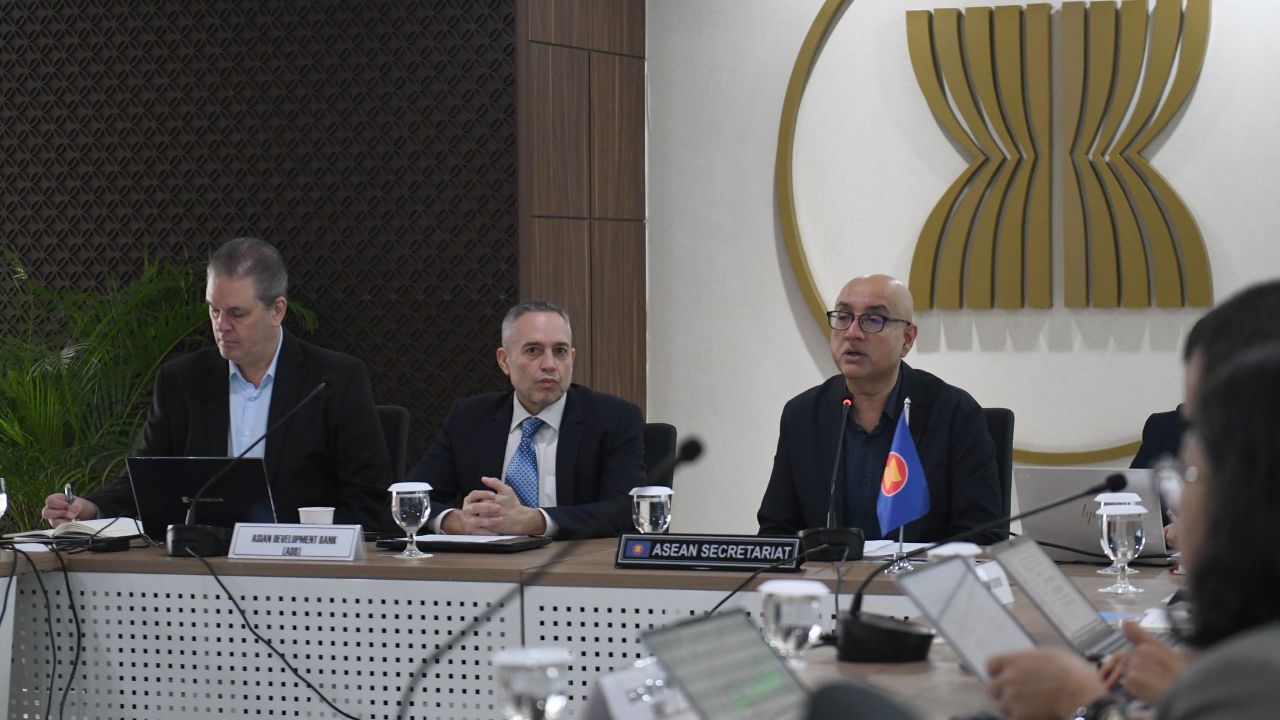
On 4 February, the ASEAN Secretariat and ADB organized a joint consultative meeting with the BIMP-EAGA Facilitation Centre, the Centre for the IMT-GT, and the GMS Secretariat in Jakarta. From left: Jason Rush, principal regional cooperation specialist at ADB; Alfredo Perdiguero, head of Regional Cooperation and Integration at ADB’s Southeast Asia Department; and ASEAN Deputy Secretary-General for ASEAN Economic Community Satvinder Singh. Photo courtesy of the ASEAN Secretariat.
Increased collaboration and coordination in agriculture, energy, and tourism is being explored.
ASEAN and three subregional programs in Southeast Asia are looking at three key sectors where increased collaboration and coordination can accelerate economic integration and promote inclusive growth. These are agriculture, energy, and tourism.
On 4 February, the ASEAN Secretariat and ADB organized a joint consultative meeting with the BIMP-EAGA Facilitation Centre (BIMP-FC), the Centre for the IMT-GT (CIMT), and the Greater Mekong Subregion (GMS) Secretariat in Jakarta. BIMP-EAGA stands for the Brunei Darussalam–Indonesia–Malaysia–Philippines East ASEAN Growth Area. IMT-GT refers to the Indonesia–Malaysia–Thailand Growth Triangle.
ADB serves as the GMS Secretariat and supports BIMP-EAGA as regional development advisor and IMT-GT as regional development partner.
The meeting discussed priorities under a joint plan of action for 2026 to 2030 to ensure alignment with the ASEAN Community Vision 2045 and its strategies, particularly the ASEAN Economic Community (AEC) Strategic Plan 2026–2030 and the Initiative for ASEAN Integration Work Plan V (2026–2030).
The joint consultative meetings were initiated in 2022 to support the implementation of the ASEAN Comprehensive Recovery Framework—the region’s exit strategy from the COVID-19 crisis. The meetings led to the development of a joint plan of action for 2022 to 2025, which focused on coordination of strategies and activities in priority sectors.
In his opening remarks, ASEAN Deputy Secretary-General for ASEAN Economic Community Satvinder Singh underscored the growing importance of strong, results-oriented cooperation with subregional frameworks as ASEAN enters the implementation phase of the ASEAN Community Vision 2045. He said priorities under the new 5-year joint action plan need to be realigned to deepen collaboration in key priority sectors and to strengthen institutional synergies in delivering tangible, on-the-ground impact that advances inclusive, resilient, and sustainable growth across ASEAN and its subregions.
Alfredo Perdiguero, who heads Regional Cooperation and Integration at ADB’s Southeast Asia Department, said the three subregional programs have advanced ASEAN’s vision of an integrated community, serving as test beds for the implementation of ASEAN policies and protocols, such as in trade and transport facilitation, tourism, and energy cooperation. Stronger strategic and institutional alignment and coordination with ASEAN, among the subregions, and at the national level in developing key sectors can help streamline project pipelines, mobilize capital for investments, and broaden the benefits of development initiatives.
Tourism is a sector where goals, strategies, and programs of ASEAN and the three subregions closely dovetail. The industry is a major economic driver in Southeast Asia, accounting for 4% of regional GDP. In January, ASEAN tourism ministers adopted the ASEAN Tourism Sectoral Plan 2026–2030 and the ASEAN Tourism Marketing Strategy 2026–2030, which promote “Southeast Asia as a single, seamless, and high-quality tourism destination through data-driven, audience-centered and digitally enabled regional marketing initiatives.” BIMP-EAGA, IMT-GT, and GMS have their own tourism strategies that have similar aspirations. In 2024, a tourism consultation meeting explored collaboration at strategic and project levels, capacity building, and partnerships, with participation from subregional secretariats, tourism working groups, ASEAN national tourism organizations, and ADB.
Energy is a top priority at the regional and subregional levels as economic expansion and a growing population fuel the demand for energy. There is renewed commitment to develop the ASEAN Power Grid, which will facilitate the sharing of energy resources, particularly renewables, through grid-to-grid connections. Its completion depends on bilateral connection projects, which are included in the project pipelines of the subregions. Meanwhile, the electrification of remote islands and rural communities presents both a challenge and an opportunity for collaboration, particularly in developing innovative solutions, such as microgrid and off-grid schemes.
Agriculture is also an important sector, contributing 9.6% to ASEAN’s GDP in 2023 and employing 93 million people. ASEAN’s Food, Agriculture, and Forestry Sectoral Plan for 2026–2030 seeks to ensure “long-term resilience, food and nutrition security, and environmental stewardship for future generations.” The subregions are major producers and suppliers of food in the region. BIMP-EAGA is known as ASEAN’s “food basket,” while the GMS is considered Asia’s “rice bowl.” IMT-GT countries are large producers of palm oil, rice, and other crops.
The ASEAN Secretariat and subregional secretariats agreed to pursue activities and develop mechanisms to promote synergy and effective coordination as well as improve monitoring and evaluation to measure and sustain progress. Planned activities include information and knowledge sharing, cross participation in meetings and events, sectoral dialogues, and joint capacity building. ADB also offered to extend participation to other ASEAN countries under its BIMP-EAGA, IMT-GT, and Greater Mekong Subregion (GMS) B-I-G Capacity Building Program, which organizes training and knowledge events for mid-career government officials.