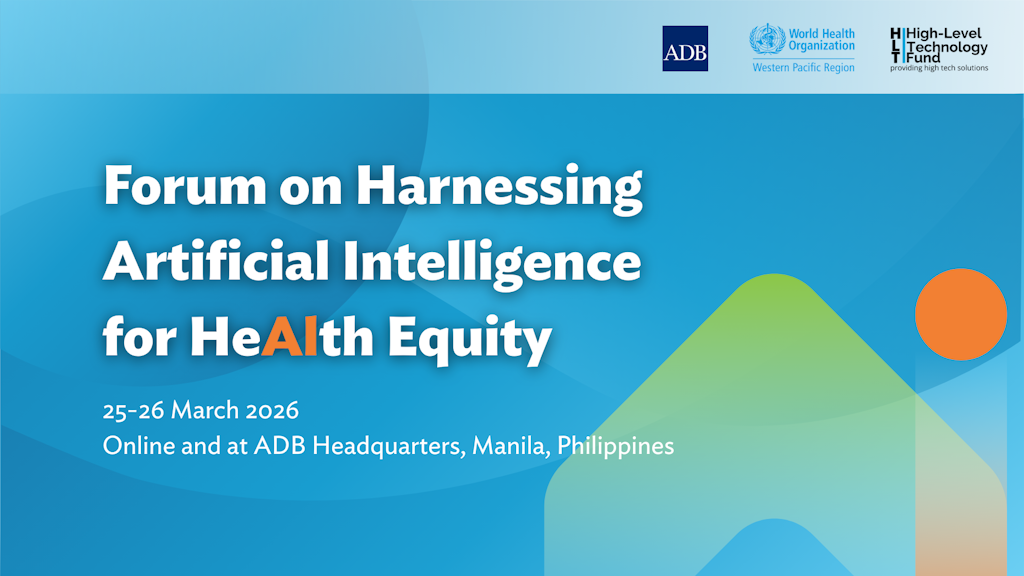
Forum on Harnessing Artificial Intelligence for Health Equity
Event Type:
Date:
Time:
Venue:
Organizer:
This event will examine how AI can be governed, financed, and scaled to deliver healthier lives for all.
Over the past decade, artificial intelligence (AI) has significantly evolved in complexity, performance, and utility. Its integration across a wide range of industrial sectors has accelerated, with healthcare emerging as one of the most transformative sectors.
In this sector, AI has enabled high-impact applications—from enhancing the speed and accuracy of disease diagnosis and supporting clinical decision-making, to strengthening public health initiatives such as disease surveillance and workforce optimization. Moreover, AI holds immense potential to empower individuals, enabling them to take greater control of their personal health and well-being. Yet the central question remains: who benefits, who is at risk, and do these innovations close or widen health inequities?
While the potential of AI-enabled applications is substantial, many countries have approached their adoption with caution. This hesitancy stems from concerns about risks and benefits, including model bias, data breaches, privacy violations, and the erosion of professional skills due to over-reliance on AI. Additional barriers include inadequate data infrastructure and a lack of robust evidence on the most effective forms and interfaces of AI to enhance service delivery and system performance. Moreover, the rapid rise of generative AI has introduced a heightened urgency for the development of comprehensive governance and ethical frameworks.
The Asian Development Bank (ADB) Health Practice Team and Digital Sector, in collaboration with the World Health Organization Regional Office for the Western Pacific (WPRO), are convening the Forum on Harnessing AI for Health Equity on 25–26 March at ADB Headquarters. Senior health officials from 16 developing member countries (DMCs), alongside leading researchers, innovators, and policymakers from across Asia and the Pacific, will engage in discussions on how AI can be governed, financed, and scaled to deliver healthier lives for all. The forum is funded through the High-Level Technology Fund with support from the Government of Japan.
The two-day forum aims to:
- Identify high-impact, evidence-based health AI use cases suitable for resource-constrained settings and map out a pipeline for potential support
- Introduce and validate the WHO WPRO policy guidance on minimum necessary ecosystem for countries and institutions to self-assess readiness for AI adoption
- Obtain initial commitment from participating stakeholders to join a pilot regional initiative focused on data/model sharing for a priority health challenge
- Endorse a prioritized set of actionable policy recommendations focusing on governance, regulation, and sustainable financing necessary to scale high-impact health AI use cases in resource-constrained settings
The forum will convene participants from Bangladesh, Bhutan, Cambodia, Cook Islands, Fiji, Indonesia, Lao People's Democratic Republic, Mongolia, Nepal, Palau, Papua New Guinea, Philippines, Sri Lanka, Thailand, Uzbekistan, and Viet Nam.
In addition, health system leaders and practitioners, private sector technologists, academic experts, representatives from civil society organizations, development partners, and philanthropic institutions engaged in AI for Health from Australia, the People’s Republic of China, Japan, Malaysia, New Zealand, Singapore, and the Republic of Korea will also be invited.
The forum will be held in a hybrid format. In-person attendance is by invitation only, while livestreaming of the forum will be available to the public. To register for Zoom participation, please complete the form on or before 24 March.