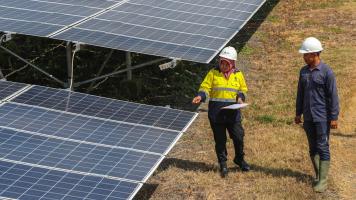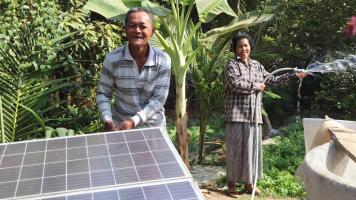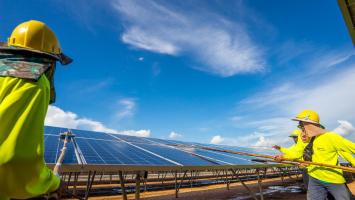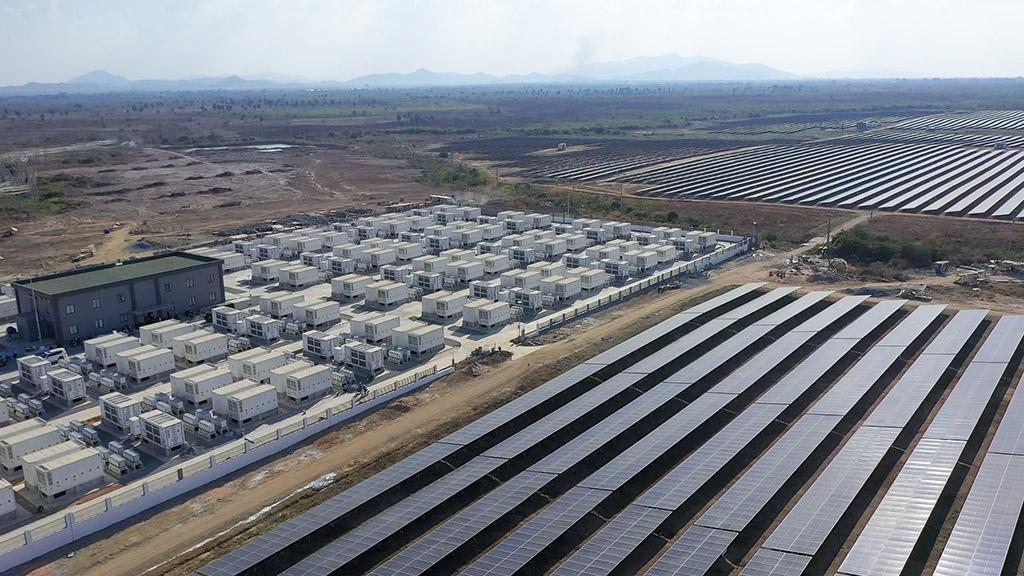
Electricité du Cambodge provided the land and grid connection for the solar park, while private developers handled the design and construction of the solar PV plants as well as associated operations and maintenance risks. Photo credit: ADB.
The first large-scale solar park in Cambodia shows how public–private partnerships and risk sharing can produce energy at competitive prices.
The National Solar Park Project in Cambodia demonstrates how large-scale solar photovoltaic farms can be developed in a cost-effective manner by mobilizing both public and private resources.
ADB provided end-to-end support for the project. This included delivering transmission interconnection infrastructure, roads, and drainage systems; transaction advisory support and advice on the private investment component of the project, including the selection of a private sector sponsor; and structuring and mobilizing funds from various sources, including concessional financing, for the construction of the first solar power plant in the park.
An international competitive tender was organized to bid out power generation units to the private sector in two phases of 60 megawatts (MW) and 40 MW. The transparent and competitive bidding process resulted in a record-low, utility-scale tariff for solar power in Southeast Asia.
The project provides a replicable model for scaling solar deployment in the region.
Strong solar potential
Ensuring reliable and affordable electricity is crucial to achieving Cambodia’s goal of becoming a high-income country by 2050. The government has prioritized the development of renewable energy, including solar, to meet growing electricity demand and achieve its target of 100% village electrification.
The country has strong solar energy potential. It has some of the highest irradiation levels in Southeast Asia with an estimated technical potential of more than 8,000 megawatts (MW). Under Cambodia’s Power Development Master Plan (2022¬–2040), which was developed with technical assistance from ADB, the share of solar photovoltaics (PV) is expected to exceed 3,000 MW by 2040.
Increasing the share of solar in the energy mix can help reduce dependence on expensive fossil fuel imports, lower electricity costs, and enhance energy supply, particularly during the dry season when hydropower is less available.
However, among the factors holding back investments were the lack of long-term project finance and the lack of credit appraisal skills for renewable projects.
Lessons from Bavet project
In 2016, ADB helped create a template for bankable projects through Cambodia’s first utility-scale solar power plant in the city of Bavet. The 10-megawatt solar power plant was the first competitively tendered renewable energy project in the country with an independent power producer.
A consortium led by Sunseap, a leading solar developer from Singapore, won the bid with a highly competitive tariff of $0.091 per kWh, which was much lower than average tariff rates of $0.30 per kWh in Cambodia at that time. As part of the project, Sunseap entered into a 20-year solar power purchase agreement with Electricité Du Cambodge, the state-owned power utility.
The Bavet project offered lessons for mobilizing and de-risking private investment in renewable energy in frontier markets. It highlighted the importance of long-term international debt financing and standard power purchase agreements as prerequisites for low-cost solar projects.
Record-low price
Building on this experience, the National Solar Park Project sought to show the ability of large-scale solar parks to further lower solar energy prices, while providing technical benefits to the national grid (e.g., voltage support during peak loading periods) and complementing hydropower generation.
ADB supported Cambodia through the One ADB approach, combining technical assistance, sovereign financing, transaction advisory services, and nonsovereign financing. The project involved ADB’s Southeast Asia Department, Climate Change and Sustainable Development Department, Office of Market Development and Public–Private Partnership, and Private Sector Operations Department.
The project assisted Electricité du Cambodge in constructing a 100-hectare solar power park in Kampong Chhnang province. It also provided transmission interconnection to a grid substation near Phnom Penh, Cambodia’s capital, to supply power to the national grid. It supported the state utility in designing and conducting an open and competitive bidding process to procure an independent power producer.
ADB’s studies showed that about 200 MW of solar energy can be added to the national grid by 2021, using available technology and without disrupting the grid.
The first 60 MW was awarded in 2019 to Prime Road Alternative Company Limited, a subsidiary of Prime Road Group from Thailand. The process resulted in a record-low price for utility-scale, grid-connected solar PV in Southeast Asia, at $0.039 per kilowatt-hours (kWh). Another 40 MW was tendered by Electricité du Cambodge in 2021 and awarded to Trina Solar Co. Ltd of the People’s Republic of China. This led to another record-low procurement price for the region at $0.026 per kWh. Both companies secured a 20-year power purchase agreement with the state-owned power utility.
Results
The project helped lower the cost of electricity, increase private sector investments in solar PV plants, and advance the transition to renewable energy in Cambodia.
When the project was completed, the average electricity cost for residential consumers decreased to $0.132 per kilowatt-hour (kWh) from $0.185/kWh while the average cost for industrial and agricultural consumers went down to $0.137/kWh from $0.147/kWh.
The 60 MW power plant started operations in November 2022 and delivered 140.9 gigawatt-hours (GWh) of solar power in 2023, surpassing the target of 135 GWh.
The 60 MW and 40 MW solar PV plants are estimated to avoid at least 148,650 tons of carbon dioxide-equivalent (tCO2e) annually or 3.864 million tCO2e over a 25-year project lifetime.
The project strengthened the capacity of Electricité du Cambodge in solar power plant construction and operation, project design and supervision, grid integration, battery energy storage systems, technical analysis, and competitive procurement.
Three additional power plants, with a total capacity of 240 MW, were built at the solar park and integrated into the national grid through electricity infrastructure financed under the project.
Key takeaways
The project showed how public–private sector solutions can be cost-effective and deliver the best results. Electricité du Cambodge provided the land and grid connection for the solar park, while private developers handled the design and construction of the solar PV plants as well as associated operations and maintenance risks.
ADB helped bridged the financing gap by mobilizing funds from various sources for the project. Sovereign financing was used to build the solar park and transmission infrastructure to reduce offtake risks and attract more private sector investment in solar energy.
Ensuring transparency and competitiveness in the bidding process boosted investor confidence and dispelled risk perceptions. The competitive tender through reverse auction resulted in a record-low tariff for the project. This shows how competition can drive down prices significantly.