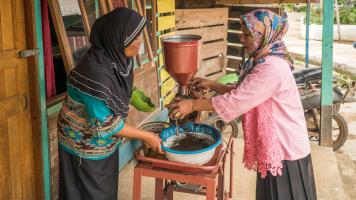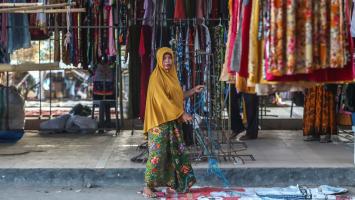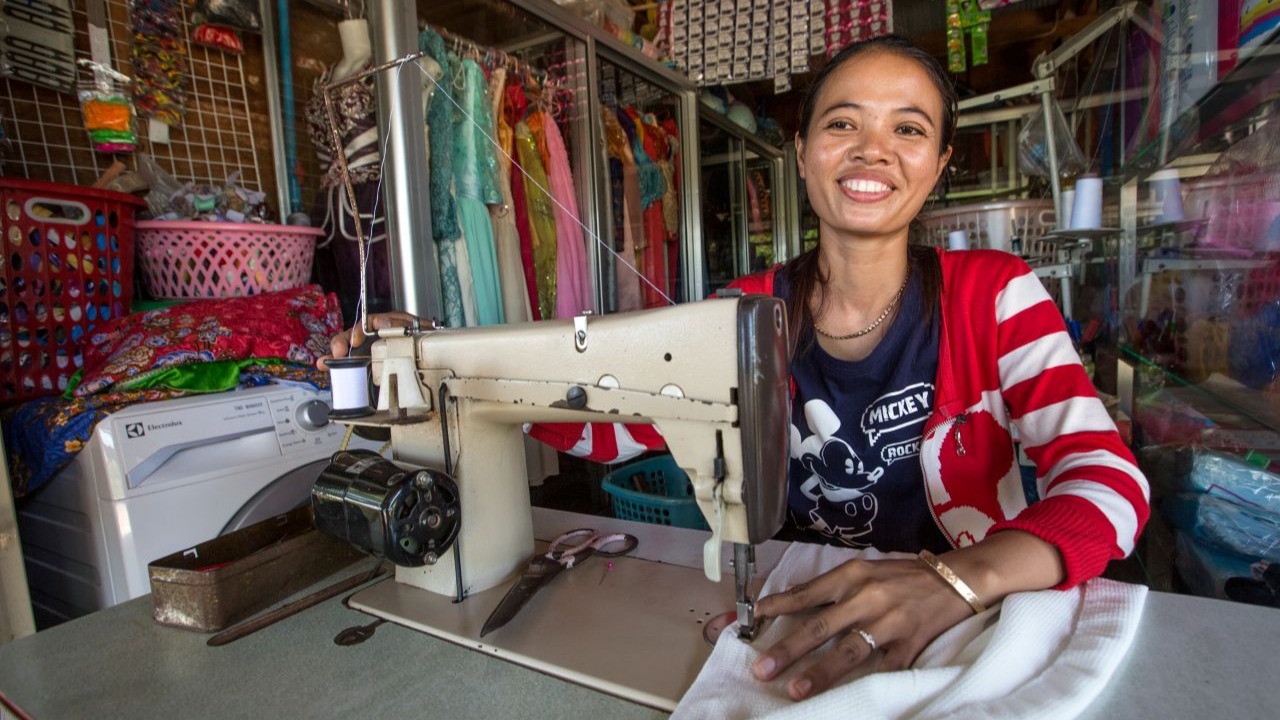
Women-owned enterprises account for 70% of firms in Cambodia, and many are classified as microenterprises. Photo credit: ADB.
Giving women-owned MSMEs greater access to knowledge, finance, and networks can improve the uptake of digital technologies and green business practices.
Women entrepreneurs hold the key to accelerating Cambodia’s progress toward a digital and sustainable society. Women-owned enterprises account for 70% of firms in the country. Many of these businesses are classified as microenterprises, which make up the backbone (about 90%) of the economy.
The Government of Cambodia is committed to advancing the country’s digital transformation and transition to climate-resilient, low-carbon development. These two objectives are part of a long-term strategy to transform Cambodia into an upper middle-income country by 2030 and to reach high-income status by 2050.
However, findings of an ADB study show that there is limited adoption of digital technologies and green practices among micro, small, and medium-sized enterprises (MSMEs) in the country. The study looked at structural and gender barriers to adoption. Factors potentially holding back women-owned MSMEs include “unequal access to knowledge, finance, and networks.” The report provides policy recommendations to address these challenges.
The study used the latest economic census and data from 414 MSMEs in the sales and accommodation sectors, which have the highest female representation, and agro-processing sector in three economic centers—the capital Phnom Penh, Battambang, and Siem Reap. Firm surveys and stakeholder interviews were also conducted.
The report was jointly developed by ADB and the Cambodia Development Resource Institute (CDRI).
Adoption rate based on enterprise size
Research analysis suggests that disparities in digital and green adoption are linked to the size or scale of the business rather than gender-specific barriers. “Medium-sized enterprises adopted the most advanced digital technologies and costliest green practices among MSMEs on average,” the report said.
Firms of the same size, whether male- or female-owned, showed little difference in rates of adoption, with microenterprises having the lowest rate, particularly in employing digital technologies.
“The commonly perceived gender difference in digital adoption might have stemmed from the gender difference in average firm size, as female owners tended to have smaller firms. Thus, to promote digital adoption among female-owned firms, it is crucial to explore broader structural barriers to business expansion and identify why female-owned enterprises remain concentrated in the micro segment.
Addressing these structural constraints could significantly advance both female economic empowerment and narrow the gender gap in digital adoption,” the report said.
Some microenterprises use digital tools but only for sales and payment. In general, there is high digital adoption in payment systems across MSMEs because of the widespread use of mobile banking in the country.
Green practices among microenterprises are limited to simple measures, such as reducing plastic and saving energy or water, while some small and medium-sized enterprises (SMEs) have shifted to using energy-efficient equipment or renewable energy, which can entail high upfront costs.
Firms of comparable size also tend to adopt similar levels of technologies and use similar digital devices and green practices.
The study identified five main barriers to digital and green adoption:
- limited information access,
- skills and knowledge gaps,
- uncertain economic benefits,
- financial constraints, and
- owners’ mindsets.
“Although the relevance of these barriers differed mainly by firm size, female-owned enterprises were disproportionately affected by limited interfirm networks, limited time availability for capacity development because of household responsibilities, and limited financial access,” the report said. Women-owned enterprises are less likely to join business associations and apply for formal loans.
Recommendations
The study suggests promoting digital and green adoption while simultaneously addressing gendered barriers with targeted actions. It recommends the following measures:
- Improve access to information and basic digital skills through a multichannel approach, such as providing online training and offline options for learning.
- Promote participation in business associations and create networking opportunities for information sharing among enterprise owners.
- Form partnerships between government agencies and educational institutions to deliver individualized training programs and targeted assistance, such as mentorship programs.
- Address gendered barriers to capacity development by offering flexible training options that consider women’s time constraints, such as shorter, module-based training sessions that are available online, in-person, or hybrid.
- Provide time-limited subsidies or matching grants for SMEs hiring skilled digital or green transformation specialists.
- Create the market conditions necessary for MSMEs to realize returns on their digital and green investments by enhancing the digital infrastructure and improving consumer awareness of digital solutions and sustainable products and services.
- Provide trial programs and demonstration facilities for digital and green adoption, as well as peer learning opportunities, to provide business owners with hands-on experience before making substantial investments.
- Provide financial education programs and offer streamlined lending processes to businesses that successfully complete the training.