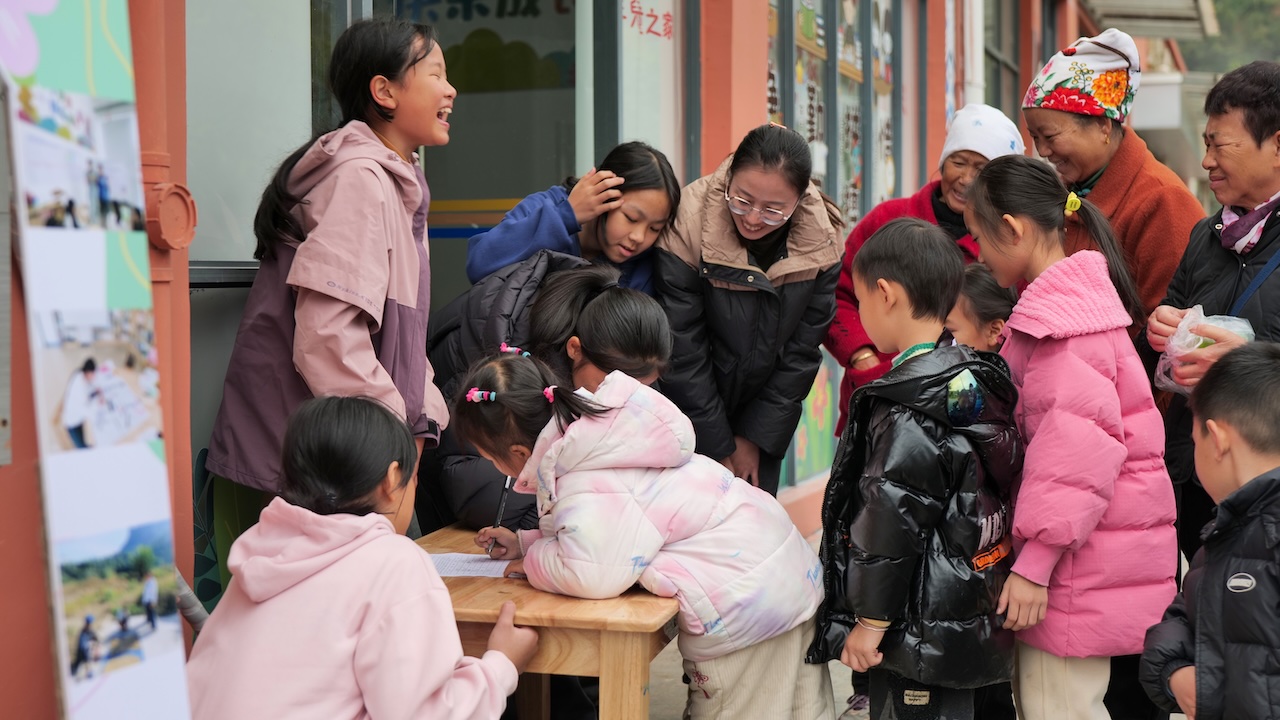
A total of 1,656 children have so far participated in empowerment sessions under the program. Photo credit: Courtesy of Save the Children.
A project focused on peer support, play, and community action empowers girls in the People’s Republic of China.
Across Southeast Asia and beyond, girls continue to navigate deep-rooted social barriers that limit their participation, voice, and opportunities.
In the People’s Republic of China (PRC), Save the Children is demonstrating what becomes possible when girls are trusted with real agency. Inside a network of child-friendly spaces in the country's southwest, girls are not merely participants, they are organizers, problem-solvers, advocates, and leaders, turning everyday challenges into community solutions.
Girls in Action: Stories from the Field
When girls have a safe environment where they can express themselves and encouraged to take action, they not just thrive, they transform their communities and themselves.
Seeing the unseen: Girls who solved a community problem. Xiao Yun and others girls in their community noticed that elderly residents struggled at an unmarked bus stop with no schedule information. The girls designed cardboard signs, presented their solution to the neighborhood committee, and secured approval for a permanent sign with an audio announcement system. A simple observation became a tangible infrastructure improvement, led entirely by girls.
Holding the keys: Leadership rooted in empathy. Feifei held the literal key to a child-friendly space in her community—a symbol of trust. She coordinated schedules, facilitated activities, and paid close attention to every child’s feelings, keeping the space active through school holidays. Her approach, leading with kindness rather than authority, inspired younger girls to step up and take on responsibilities of their own.
From whispers to walls: Making sexuality education safe and accessible. Xiao Ya identified a gap: books on sexual health were almost impossible to find. She responded by initiating a sexuality education corner within the space, designing colorful posters, curating resources, and creating a welcoming space where girls could learn about adolescent health and rights without fear of judgment. What began as a quiet conversation among friends became a resource used by girls across the community.
From gray gates to colorful dreams: Girls redesign their space. Eleven-year-old Xiao Jie led her peers in decorating the community gate and creating paper flower beds, transforming a neglected entrance into a vibrant, welcoming space. “As long as we dare to dream and act,” she said, “nothing is impossible.” The process gave girls a sense of ownership—over their space, their ideas, and their community.
These stories have a common thread: when girls are trusted and supported, they become powerful agents of change. Child-friendly spaces are not just service points for the local communities, but incubators where girls exercise autonomy, make decisions, and lead with creativity and courage.
The Girls-Led Mechanism: How It Works
These stories are not isolated moments, they are the product of a structured, replicable girls-led mechanism designed by Save the Children PRC. Built on four core approaches, the model places girls at the center of decision-making and action:
- Girls Decide Toolkit: More than a set of exercises, this participatory toolkit empowers girls to choose the issues they care about, design their own activities, and lead awareness campaigns. Adapted to local community situations and operated by trained social workers, it functions simultaneously as an operational guide and a monitoring tool—ensuring girls remain at the center of both design and accountability.
- Learning through Play: All activities are designed using playful, creative, and age-appropriate methods that help girls build confidence, collaboration, and problem-solving skills. This method goes beyond pedagogy to become a tool for exploring complex topics—including body autonomy and consent—through games, skits, and storytelling. This approach makes difficult conversations safe and accessible, particularly for younger girls navigating these issues for the first time.
- Girls’ Support Network Model: Peer support networks form the backbone of continuity within the mechanism. Girls encourage one another, make decisions collectively, and take action together. Crucially, these networks hold strong even when individual girls graduate or move away—because the connections and sense of shared purpose outlast any single participant.
- Adult Support: The entire structure is underpinned by a deliberate redefinition of adult roles. Teachers, social workers, parents, and community stakeholders are trained not to direct activities, but to step back and create space for girls to lead. This shift—from instruction to enabling—has been critical to sustaining girl-led initiatives over time.
Together, these approaches have produced a new model of girls’ leadership; non-hierarchical, inclusive, and rooted in empathy. Rather than appointing leaders, girls co-create leadership structures where every member’s needs are heard and integrated into collective planning. Their approach is both emotionally intelligent and structurally sound: discussions within girls-led groups reflect logical thinking, clear role distribution, and a high degree of peer care. Notably, this model has also been effective at drawing in children with special needs, a marker of genuinely inclusive leadership in practice.
Impact
The results demonstrate what girls-led programming can achieve when properly resourced and sustained:
- 1,656 children participated in empowerment sessions.
- 95 advocacy campaigns organized and led by girls, addressing anti-bullying, safety, and community improvement.
- 26 girls-led groups established across communities and schools.
- 136 frontline workers trained in child protection and empowerment facilitation.
- Girls aged 10–13 reported significant gains in self-esteem, public speaking, creativity, and problem-solving.
The model has been recognized by the local Civil Affairs Department as a replicable approach to participatory, child-friendly communities, and is being piloted for broader rollout.
At the household level, parents and community stakeholders are increasingly listening to girls’ voices, challenging gender stereotypes, and actively supporting girls’ decisions on family and community affairs—a cultural shift as significant as any program metric.
The combination of girls-led groups, a functioning training network, and government institutionalization ensures that the empowerment framework will continue to grow beyond the project cycle—a model with clear potential for adaptation across communities in Southeast Asia and the wider region facing similar structural inequalities.
About the Project
These activities are part of the Girls Unstoppable Project—a collaboration between Save the Children PRC, the LEGO Group, and the LEGO Foundation, implemented from 2024 to 2026. The project targets the complex social pressures and developmental constraints faced by girls, supporting them to develop their potential and become advocates and leaders for their own rights.
Save the Children
Save the Children is an independent children’s organization, transforming lives and the future we share. We’re proud to work with children, their communities, and our partners worldwide, discovering new solutions to help ensure that the world's most vulnerable children survive, learn and are protected.