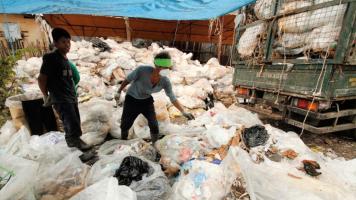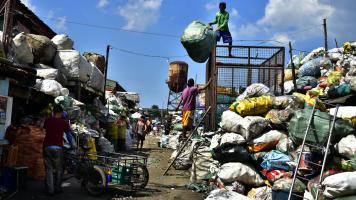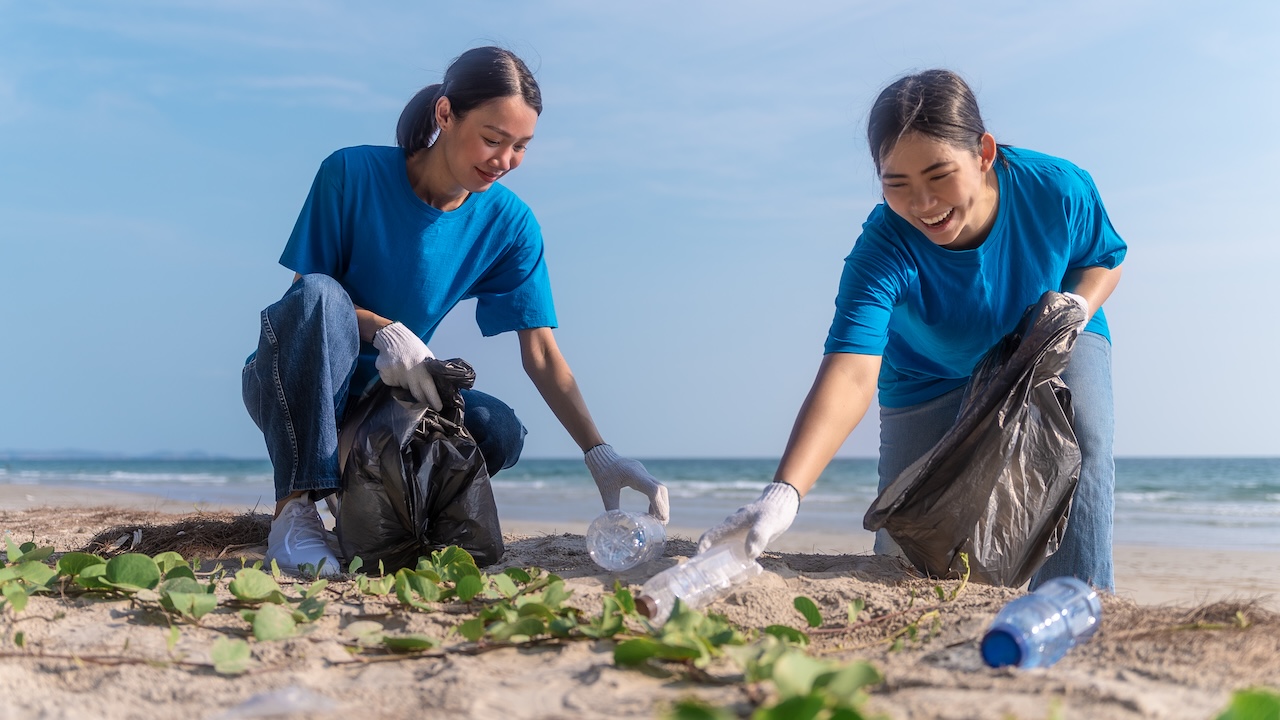
Economic instruments deemed effective in reducing plastic pollution include taxes on virgin plastics, tax incentives for recycling investment, green public procurement, single-use plastics levies, advanced recycling fees, and deposit-refund systems. Photo credit: iStock/Theerawit Jirattawevut
Using economic instruments to influence producer and consumer behavior through the forces of supply and demand seen to address plastic pollution.
Thailand is seeking to accelerate plastic circularity as part of efforts to address plastic pollution.
The plastics industry contributes almost 8% of the country’s gross domestic product. Every year, almost 3 million metric tons of mainly virgin plastics are turned into single-use plastics. But this, coupled with the leakage in waste management systems has resulted in the country being one of the largest sources of marine plastic pollution worldwide.
The government, under its Plastic Waste Roadmap (2018–2030), is promulgating a legal framework for sustainable management of packaging that will enable the introduction of economic instruments.
To help the government, the Asian Development Bank (ADB) conducted a study to provide insights that could encourage the introduction of economic instruments to stimulate a circular economy in Thailand. Economic instruments are market-based policy tools designed to influence producer and consumer behavior through the forces of supply and demand to achieve desired outcomes.
The study identified six economic instruments that can reduce plastic pollution. These are: taxes on virgin plastics, tax incentives for recycling investment, green public procurement, single-use plastics levies, advanced recycling fees, and deposit-refund systems.
1) Taxes on virgin plastics and exemptions for recycled plastics
Taxes can be imposed on virgin plastics to internalize the environmental costs associated with plastic production and disposal. This can include the costs associated with plastic pollution, greenhouse gas emissions, and various other environmental impacts. Imposing taxes will increase the price of virgin plastics and can encourage packaging producers and companies providing packaging and filling services to reduce the use of virgin plastics. The increased price of virgin plastics may in turn make substitutes and replacements, including recycled plastics, more attractive.
In Italy, virgin plastics are taxed at €0.45 ($0.52) per kilogram (kg). In the United Kingdom, the tax was set initially at £200 ($265.69) per ton when it first came to effect in 2022, before rising to £210.82 in 2023.
This economic instrument can be introduced under Thailand’s existing laws. For example, the Revenue Department issued Decree No. 749 under the Revenue Code in 2022 to allow companies purchasing certified biodegradable plastics to get a tax credit of 125% off the purchase. This temporary measure was successful and was renewed to the end of 2024.
2) Tax incentives for recycling investments
Tax incentives for recycling investments refer to tax exemptions and tax breaks offered by a government to businesses investing in equipment and infrastructure for recycling operations. The tax savings are designed to draw more capital into the recycling industries. More plastic waste is expected to be diverted to this sector to meet the added capacity. This can increase the supply of recycled plastics and improve their competitiveness in relation to virgin plastics in the longer term.
In the Republic of Korea, recycling plants are entitled to several benefits, including soft loans; tax credit for investments in environmental facilities and equipment; and subsidies for research and development. In Indonesia, there is an initiative to provide incentives for recycling by lowering the value-added tax from 10% to 5% for recycling businesses.
In Thailand, the Board of Investment has already offered various levels of exemption from corporate income tax to circular economy businesses.
3) Green public procurement (GPP)
This economic instrument focuses on purchasing environment-friendly goods and services with minimal impact on the environment. GPP entails considering the entire life cycle of a product or service, from the procurement of raw materials to production, energy usage, packaging, transportation, and its use and disposal. GPP is particularly relevant to the plastic packaging
industries since it promotes energy- and resource-saving products, low emissions and waste, and the use of recycled or processed raw materials. With this instrument, the government can use its purchasing power to popularize environment-friendly products. Other institutional users may likewise adopt similar procurement policies, creating more demand in the market.
In Spain, Mutualia, a mutual insurance company that provides workplace accident insurance, health care, and rehabilitation services, implemented corporate-level GPP measures at 17 of its service centers. These measures tackled plastic waste and reduced expenses related to bottled water consumption by installing water fountains. In total, 147,000 plastic cups; 4,000 large plastic water cooler bottles; and 7,000 small plastic bottles were avoided. These resulted in an estimated savings of €17,000 per year on drinking water expenses for patients, employees, and visitors.
4) Single-use plastic packaging levies and rebates for reusable containers
Levies on single-use plastic (SUP), such as the “latte levy,” are designed to discourage the use of SUPs and promote environment-friendly packaging alternatives. These types of measures can help reduce plastic waste and encourage businesses and consumers to adopt more sustainable packaging solutions. Funds generated from taxation can be used in many ways, such as supporting waste management initiatives, developing recycling infrastructure, conducting educational campaigns, and undertaking research for sustainable alternatives.
In Japan, the government has imposed a mandatory charge on single-use plastic bags since 2020. The levies are between ¥3 and ¥5 ($0.02–$0.03) for each plastic bag, which has reportedly led to an 80% reduction in the use of plastic bags. In parallel, a rebate can be offered to customers who bring reusable containers, which has already become common practice in Japan.
In the future, Thailand could impose a standardized levy on SUPs under the Sustainable Packaging Management Act. The revenues raised could be allotted for the National Environment Fund to support cleanup projects that remove plastic pollution from the environment.
5) Advanced recycling fees
Advanced recycling fees (ARF) can be introduced under the draft Sustainable Packaging Management Act. This will constitute a financial obligation where the revenues from ARFs would be managed by a producer responsibility organization (PRO) to finance the collection, transportation, processing, recycling, and disposal of packaging waste. This extended responsibility fee may trigger design changes that reduce the use of packaging, as seen in some industrialized economies. In addition, the earmarked revenues can boost the collection and recycling of targeted materials as well as support cleanup activities.
Taipei,China has implemented an extensive recycling program, called the 4-in-1 Recycling Program, since 1997. Manufacturers and importers of designated products and packaging are obliged to pay ARFs into a government fund. The fund then pays subsidies for the recycling of these materials.
The Federation of Thai Industries is currently testing the mechanisms of a PRO. Member companies contribute financially to the project, which provides support to infrastructure development and purchase assistance subsidies for targeted materials. However, industries need legal backing to gain greater participation from the producers and to prevent free riders so as to create a level playing field.
6) Deposit-refund system
The deposit-refund system (DRS) is an economic instrument designed to use the deposit paid by consumers at the point of sale as an incentive in the form of a refund when they bring packaging back after use for refilling or recycling. Specifically, the DRS leverages the deposit payment for products that contribute to pollution. The deposit is often included in the price of the product. Consumers then receive a refund when they return the product to designated locations after use or after completing the production process. This intervention can increase the collection rate of plastic packaging as seen in the implementation of such systems in other countries.
Israel, for example, has implemented a deposit-refund law that requires a deposit of 0.25 Israeli new shekel ($0.08) on small plastic or glass containers (less than 1.5 liters). This DRS has effectively incentivized recycling, leading to higher rates of bottle returns and reduced littering.
In Thailand, there is a DRS for refillable containers, such as glass bottles, which works because of the value of the reusable packaging. Instituting a similar mechanism for one-way packaging that has significantly lower value will require policy intervention and a new law.
“Each of these instruments can prevent a significant amount of plastic waste from leaking to the ocean,” said the ADB study. Their combined effects would be even greater when the revenues collected are channeled to the waste management sector, improving its service coverage, collection, and treatment to achieve greater plastic circularity.