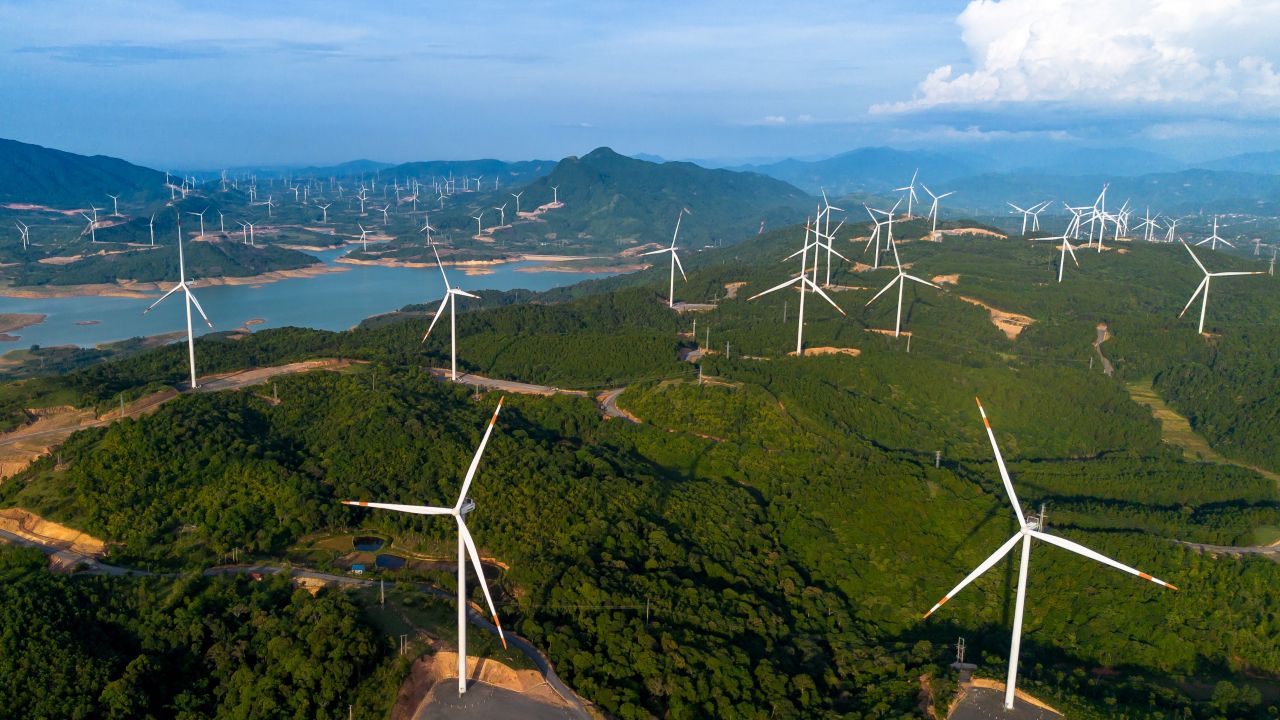
Mobilizing green finance to support a just transition. ADB partnered with JICA and other international lenders to provide green loans to the Lotus Wind Power Project in Viet Nam. Photo credit: ADB.
Coordinated regional action can accelerate technology adoption and interoperability and mobilize transition finance.
Southeast Asia is hard-pressed to transition high-emitting industries to net-zero to avoid the potential doubling of annual emissions by 2050. Studies show carbon emissions have more than doubled in the region from 1990 to 2023, and are projected to rise annually by 3% unless countries decouple economic expansion from fossil fuels.
Regional cooperation is key to undertaking the complex task of decarbonization, says a joint report by ADB, Economic Research Institute for ASEAN and East Asia (ERIA), and Japan’s Ministry of Economy, Trade and Industry (METI). Hard-to-abate sectors, primarily power, industrial (particularly steel, cement, and chemicals), and transport, account for more than 70% of projected emissions in 2025.
The report calls for “collaborative action across Southeast Asia and beyond” to put in place supportive policy frameworks, mobilize transition finance, and accelerate technology adoption. Proposed measures include establishing regional standards and financing mechanisms particularly for early-stage industrial decarbonization projects.
The report also presents roadmaps that chart potential technology adoption for hard-to-abate sectors based on development objectives as well as financing, policy, and technical considerations. It provides case studies of how difficulties were overcome to scale up renewables, build green-enabling infrastructure (ASEAN Power Grid), and decarbonize hard-to-abate and high-emitting assets (e.g., coal-fired power plant).
Challenges
Majority of the ASEAN member states have announced net zero emissions targets. However, many challenges impede countries in the region from transitioning to a low-carbon economy.
“Unlike advanced economies where emissions have begun to decline, Southeast Asia still show a strong link between economic growth and rising emissions driven heavily by coal plants and carbon-intensive industrial development,” the report says. The region faces a trilemma of balancing competing priorities: energy security, energy affordability, and environmental sustainability.
The report focuses on the power and industry sectors, which are the largest sources of emissions in Southeast Asia and where there is a lack of commercially viable or cost-effective low-carbon solutions. Decarbonizing these hard-to-abate sectors require “significant innovation, capital, and policy coordination.”
Coal-fired power generation is still a major source of electricity in many countries in the region, where energy demand is rising fast. Many of the coal-fired power plants are relatively young, averaging less than 15 years old, “making early retirement financially and politically difficult.” Meanwhile, high-emitting industries, such as chemical, cement, and steel, rely on “fossil fuels for high-temperature heat, feedstocks, or process emissions.”
Other challenges include lack of access to green or transition technologies, such as green hydrogen and carbon capture, use, and storage, and technical expertise; grid challenges in integrating variable renewables (e.g., solar, wind); fragmented policies, inconsistent standards, and limited interoperability; and lack of enabling policies for a just and inclusive energy transition.
Solutions
The report sees transition finance as a “critical enabler” for decarbonization projects that are considered high capital and high risk. Also, transitioning hard-to-abate sectors typically involve brown-to-green projects, which cannot access climate finance.
Support for first-of-a-kind projects is important to enable the region to test new solutions and business models, particularly for hard-to-abate sectors, that could open a realistic pathway toward net zero emissions.
“In the context of Southeast Asia, this might mean a green hydrogen plant using locally sourced renewables, a blue ammonia facility in an emerging market, or a novel carbon capture installation tied to industrial output,” the report says. “Because there is no track record to draw from, these projects often face skepticism from investors, higher risk premiums, and regulatory gaps that slow progress.”
Regional standards and financing mechanisms can facilitate the replication of successful pilot projects across the region.
Regional initiatives, such as the Asia Zero Emission Community (AZEC), can serve as platforms to align technical standards, policy frameworks, and financing criteria as well as support infrastructure planning, promote joint technology development, and crowd in financing and expertise from advanced economies, international organizations, and the private sector.
Established in March 2023, AZEC comprises 11 partner countries— Australia, Brunei Darussalam, Cambodia, Indonesia, Japan, the Lao People’s Democratic Republic, Malaysia, the Philippines, Singapore, Thailand, and Viet Nam. It was proposed by the Government of Japan to promote cooperation toward carbon neutrality and net zero emissions.
The report also proposed a regional financing facility dedicated to industrial transition. “Anchored by ADB, it would provide concessional capital and technical assistance to early-stage industrial transition projects, particularly those aligned with national and regional net zero strategies. An institution like AZEC could play a convening and coordination role, helping align national priorities, facilitate public–private dialogue, and promote interoperability of taxonomies and MRV [monitoring, reporting, and verification] systems. The facility could also draw on Japan’s green transformation (GX) bond experience to structure long-term financing instruments with clear use-of-proceeds categories.”
The report calls for decisive action. “There is a narrow window of opportunity. Governments and development partners must treat energy transition projects not as isolated experiments but as a necessary first step in building the institutional, financial, and regulatory infrastructure for a low-carbon industrial future.”